Code
source("../dsan-globals/_globals.r")
set.seed(5300)DSAN 5300: Statistical Learning
Spring 2026, Georgetown University
Today’s Planned Schedule:
| Start | End | Topic | |
|---|---|---|---|
| Lecture | 6:30pm | 7:00pm | Symbolic Regression: What Can a Machine Learn? → |
| 7:00pm | 7:20pm | Comparing Between Groups → | |
| 7:20pm | 8:00pm | Regression (Cox Proportional Hazard Model) → | |
| Break! | 8:00pm | 8:10pm | |
| 8:10pm | 9:00pm | Quiz 3 → |
source("../dsan-globals/_globals.r")
set.seed(5300)\[ \DeclareMathOperator*{\argmax}{argmax} \DeclareMathOperator*{\argmin}{argmin} \newcommand{\bigexp}[1]{\exp\mkern-4mu\left[ #1 \right]} \newcommand{\bigexpect}[1]{\mathbb{E}\mkern-4mu \left[ #1 \right]} \newcommand{\definedas}{\overset{\small\text{def}}{=}} \newcommand{\definedalign}{\overset{\phantom{\text{defn}}}{=}} \newcommand{\eqeventual}{\overset{\text{eventually}}{=}} \newcommand{\Err}{\text{Err}} \newcommand{\expect}[1]{\mathbb{E}[#1]} \newcommand{\expectsq}[1]{\mathbb{E}^2[#1]} \newcommand{\fw}[1]{\texttt{#1}} \newcommand{\given}{\mid} \newcommand{\green}[1]{\color{green}{#1}} \newcommand{\heads}{\outcome{heads}} \newcommand{\iid}{\overset{\text{\small{iid}}}{\sim}} \newcommand{\lik}{\mathcal{L}} \newcommand{\loglik}{\ell} \DeclareMathOperator*{\maximize}{maximize} \DeclareMathOperator*{\minimize}{minimize} \newcommand{\mle}{\textsf{ML}} \newcommand{\nimplies}{\;\not\!\!\!\!\implies} \newcommand{\orange}[1]{\color{orange}{#1}} \newcommand{\outcome}[1]{\textsf{#1}} \newcommand{\param}[1]{{\color{purple} #1}} \newcommand{\pgsamplespace}{\{\green{1},\green{2},\green{3},\purp{4},\purp{5},\purp{6}\}} \newcommand{\pedge}[2]{\require{enclose}\enclose{circle}{~{#1}~} \rightarrow \; \enclose{circle}{\kern.01em {#2}~\kern.01em}} \newcommand{\pnode}[1]{\require{enclose}\enclose{circle}{\kern.1em {#1} \kern.1em}} \newcommand{\ponode}[1]{\require{enclose}\enclose{box}[background=lightgray]{{#1}}} \newcommand{\pnodesp}[1]{\require{enclose}\enclose{circle}{~{#1}~}} \newcommand{\purp}[1]{\color{purple}{#1}} \newcommand{\sign}{\text{Sign}} \newcommand{\spacecap}{\; \cap \;} \newcommand{\spacewedge}{\; \wedge \;} \newcommand{\tails}{\outcome{tails}} \newcommand{\Var}[1]{\text{Var}[#1]} \newcommand{\bigVar}[1]{\text{Var}\mkern-4mu \left[ #1 \right]} \]
Thus far, we have either…
Slides derived from Andrew Jiang’s very helpful slides!
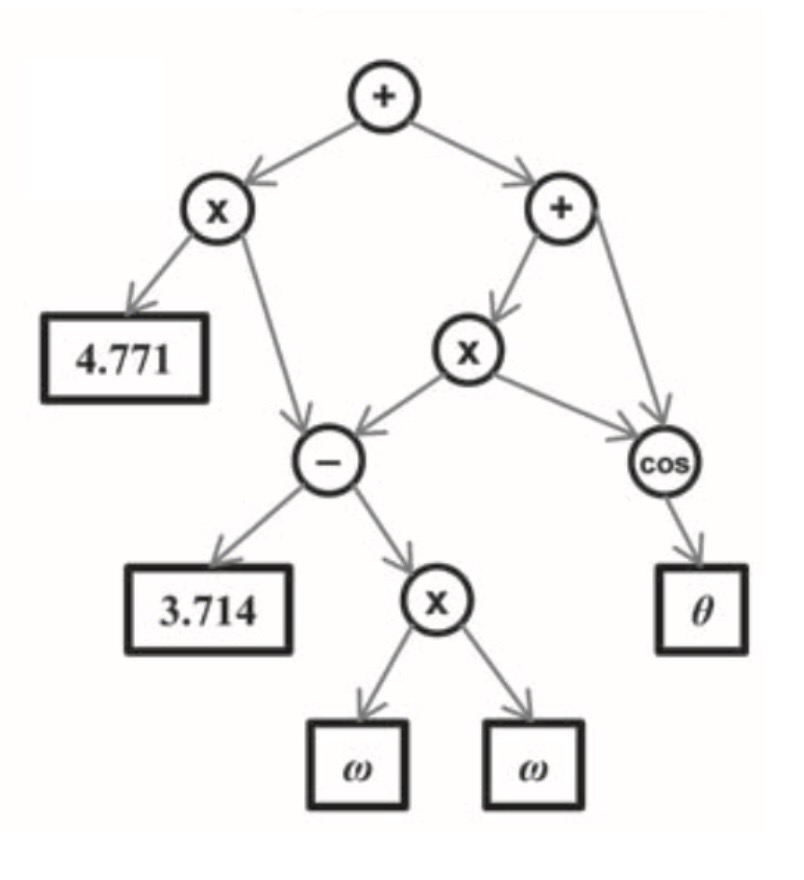
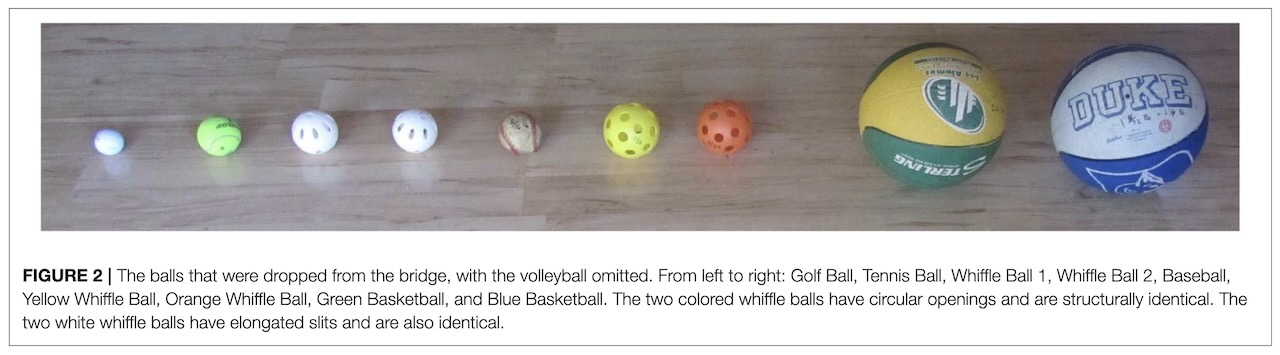
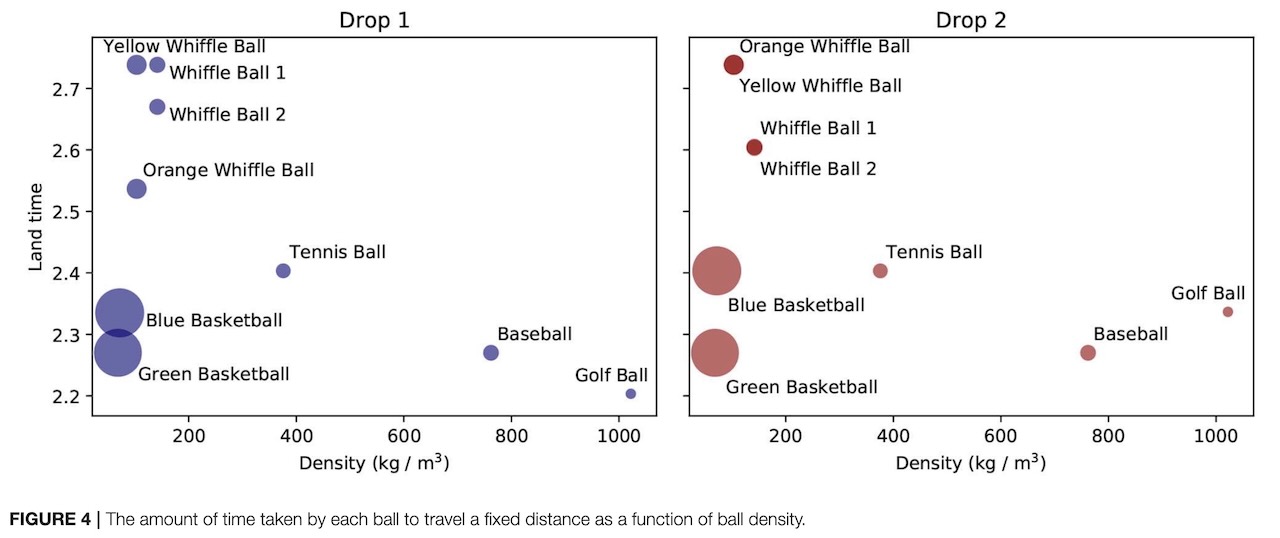
SR Result:
\[ \begin{aligned} \text{distance} = &4.2026 t^2 + 0.0177 m^2 + 0.5456 tm \\ &− 0.006564 ct - 4.2614 \times 10^{-4} cm \\ &+ 2.5633 \times 10^{-6} c^2 \end{aligned} \]
From Newton’s Laws:
\[ \text{distance} = \frac{g}{2}t^2 \]
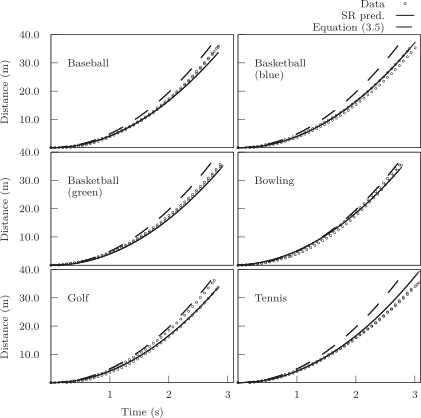
| Accuracy | Equations in Sequence | Event |
|---|---|---|
| -1.4197 | \(x + x - c_3 - y\) | random |
| -1.41347 | \(x + x + x - c_4 - y\) | mutation |
| -1.41339 | \(x + x + x - \sin(c_3) - y\) | mutation |
| -1.13805 | \(x + x + x - \sin(y) - (x - x)\) | crossover |
| -1.08904 | \((x + x)\cdot x - \sin(y) - (x - x)\) | mutation |
| -1.08574 | \((x + x)\cdot x - \sin(y) - c_1\) | mutation |
| -1.01841 | \((x + x)\cdot x - y - c_1\) | mutation |
| -0.978484 | \((x + x + x)\cdot x - y - c_{13}\) | mutation |
| -0.914336 | \((x + y - c_3)\cdot y + x\cdot x \cdot c_{15}\) | mutation |
| -0.303559 | \((x + y - c_4)\cdot y + x \cdot x \cdot c_{15}\) | mutation |
| -0.0692607 | \((x + y - \sin(x))·y + x \cdot x \cdot c_{15}\) | crossover |
| -0.0140815 | \((x + y - x)·y + x·x·c_{15}\) | mutation |
| -0.0050732 | \((x + y - x)·y + x·x·c_{16}\) | mutation |
| -0.0050732 | \(y \cdot y + c_3 \cdot x \cdot x\) | mutation |
Quiz 12