Week 5: From DuckDB to Polars
DSAN 6000: Big Data and Cloud Computing
Fall 2026
DuckDB \(\rightarrow\) Polars Roadmap
DuckDB nice to know, but in this class mainly as intro to querying
.parquet(More advanced DuckDB queries = more advanced SQL; outside scope of class!)
Polars we’re learning for its own sake: augment Pandas w/lazy evaluation
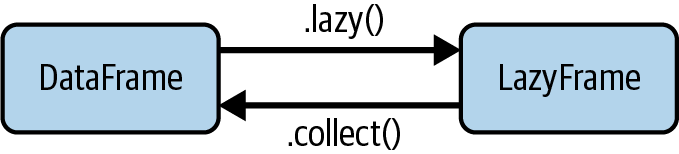
Janssens and Nieuwdorp (2025) p. 98, Figure 5.1
HW5: No More Shoving SQL in Python with """
- DuckDB: “Artificial” separation of computation and data
HW4 Q3 Data loaded into Pandas
DataFrameHW4 Q3 Computation written as SQL expression:
query = """
<SQL code>
"""
…Then you shoved them together:
result_df = con.execute(query).df()
- Polars: “Natural” computation-data separation within the same language (Python)
- HW5 Q2 Data loaded into Polars
DataFrame(Python object) - HW5 Q2 Computation written as Polars functions (Python code)
polarslibrary specifies which functions “activate” eager evaluation
- HW5 Q2 Data loaded into Polars
A Less-Rushed Introduction to DuckDB
- DuckDB = “SQLite for OLAP (Columnar Patterns)”
- SQLite = “DuckDB for OLTP (Row-Based Patterns)”
DuckDB: Buzzwords \(\leadsto\) Understanding
DuckDB is an in-process SQL OLAP DBMS. (Aubury 2024)
Database Management System (DBMS): An interface between the database and its users, allowing create, read, update, and delete (CRUD) operations on the DB
Online Analytical Processing (OLAP): A data processing paradigm focused on applying column-wise aggregation functions and joining large datasets together
(Contrasts with Online Transaction Processing (OLTP), where frequent writing of individual records (rows) is the dominant pattern of data interaction)
Structured Query Language (SQL): A declarative programming language used to store, manipulate, and query records in relational databases – DBs representing data as tables of rows and columns, with formal relationships defined across tables
In-process: DuckDB embeds within a process + its memory. Most DBMSs run separately (e.g., on a remote server); DuckDB eliminates connect/authenticate steps
DuckDB as Ephemeral DB-In-RAM
Standalone operation (as its own process, independent of Python): DuckDB CLI
Python operation: Upon
import duckdb, creates a default, in-memory DBdefault_mem_con = duckdb.connect(database=':default:')Typically not used, if only bc less clear where and when the DB was created (readers of your code would need to know this fact aboutimport duckdb)Setting up a connection creates a new,
con-specific in-memory DB:con = duckdb.connect(database=':memory:') con = duckdb.connect() # database=':memory:' is default settingCan persist to file on disk:
con = duckdb.connect('my_cool_data.duckdb')Please note
duckdb.connect()is not how we connect to the on-disk data files, external S3 objects, or in-memoryDataFrames that we want to run queries on!con.execute('SELECT * FROM my_df LIMIT 5;')
SQLite: “DuckDB for OLTP”
- Both are simplified in-process DBMSs that connect to a single local file (also both free and open source)
- SQLite optimized for row-oriented, OLTP workloads
- DuckDB optimized for column-oriented, OLAP workloads
- HW6 will give you exposure to both!
- SQLite for OLTP ingestion of events
- Athena (coming soon) for “automatic” ETL
- DuckDB for OLAP inference (MLFlow)
Why Mention SQLite?
- Next week, when we dive into AWS Athena (Virtuoso et al. 2021), we will be bridging OLTP and OLAP
- The more “ambidextrous” you can be – comfortable with both row-based and columnar workflows – the better you’ll be at building and debugging \(\text{OLTP} \overset{\text{ETL}}{\longrightarrow} \text{OLAP}\) pipelines!
A Non-Sprinted Introduction to Polars
- Eager vs. Lazy Evaluation
- Building Expressions
- In-Class Demo!
Polars (Jeff’s Mental Model)
- Polars =
DataFramelibrary in Rust for fast (query-optimized), distributed OLAP workflows polars=DataFramelibrary in Python, “high-level” (Python-level) “wrapper” around underlying Polars code- If we want optimized, distributed processing, we need lazy execution (enabling logical \(\leadsto\) physical query plan)…
- Query optimization via lazy execution not part of
pandas! - \(\implies\) Let’s find a lazy-execution-focused library that “feels” as close to Pandas as possible… that’s
polars!
pl.DataFrame vs. LazyFrame
- Polars has two “types” of
DataFrames… “Types” in quotes because, aLazyFramedoesn’t actually contain any data! - A
LazyFrameis a plan (using expressions) for creating apl.DataFrame - Call
lf.show_graph()to show Polars’ optimized query plan - The special function
collect()is what actually executes the plan, materializing the result as apl.DataFrame
LazyFrames = “Plans” = Strings of Expressions
- Since we’re in OLAP mode, we’ll almost always be using columns as our core objects
- \(\implies\) Most Polars expressions involve
pl.col():pl.col('*')is the expression «all columns»pl.col(pl.String)is the expression «all string columns»pl.col('Age')is the expression «the column named'Age'»pl.col('Age') > 20is the expression «the col named'Age'is greater than 20»
- We then use expressions
evia predicates:pl.select(e)to keep only columns matchingepl.filter(e)to keep only rows matchingepl.with_columns(e)to create new columns based onepl.group_by(e).len()to group based one(then aggregate, here by counting)