Week 4: Columnar Data Formats and DuckDB
DSAN 6000: Big Data and Cloud Computing
Fall 2026
Class Sessions
Computer Architecture in One Diagram
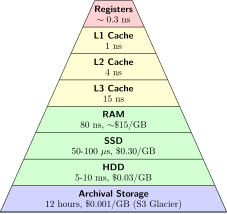
- Storage ↑ higher on pyramid is faster but more expensive
- Registers, Caches built into processor
- Everything from RAM upwards uses electricity ⚡️, dies when unplugged
- Solid-State Drives (SSDs) have no moving parts (“flash memory”)
- Hard-Drive Disks (HDDs) have moving parts: “heads” which scan over spinning magnetic disk then read data sequentially
The Problem With CSVs (for Data Engineers)
| Inherent ambiguities… | No built-in way to communicate schema info! | |
|---|---|---|
| Delimiter: Comma? Tab? Semicolon? | Schema information: Sent or looked up separately (codebooks) | |
Quote characters: Single ' or double " quote?ASCII "" or UTF-8 “”? |
Nested structures: …Improvised and included in schema |
|
Escaping special characters: \n = new line, or part of string val? |
||
\(\leadsto\) Data engineers working with CSV data have to build robust error detection systems to ensure data quality (Pydantic! Pandera!)
The Problem With CSVs (for Data Scientists)
- Brainstorming exercise: What kinds of operations do you think of when you think of “doing” data science?
- For me:
mean(),std(),max(),min(), etc… - Computing SSRs:
(df['y'] - df['y_pred']) ** 2 - These are columnar operations, yet
.csvfiles are read row-by-row
How CSVs Are Actually Stored on Disk
dsan6000_staff.csv
staff_id,last,first,points\n1,jacobs,jeff,300\n2,vakkalanka,samyu,400\n3,wang,fangzhou,500\n4,wu,siru,600- …Even if we only want to compute average of last column, computer has to scan over all data in row first (remember: sequential memory reads)
…But Imagine A World Where… (John Lemon, from Beetles)
dsan6000_staff.csv
points,300,400,500,600\nstaff_id,1,2,3,4\nlast,jacobs,vakkalanka,wang,wu\nfirst,jeff,samyu,fangzhou,siru- …But I completely cheated here! I moved the last column to be the first column. How could we achieve this in practice?
The Skip List Approach
(Note: If you took DSAN 5000, you saw the skip list data structure… here we’re generalizing this to DataFrames!)
Now imagine a fancier header, with an index telling the reader the exact byte where each column starts:
| column name | column start |
|---|---|
staff_id |
0 |
last |
18 |
first |
50 |
points |
82 |
Even more efficient if we implement index as Binary Search Tree
Sidenote Now, Important Later
If we did have a setup where we wanted to operate over rows, this optimized-index approach would work just as well!
Sorted Data:
- If sorted by
staff_id: 1000 employees total, employee 500 starts at byte 820 - \(\leadsto\) (Higher ids guaranteed to be in later bytes)
Time Series Data:
- 2020 data starts at byte 0
- 2021 data starts at byte 458
- 2022 data starts at byte 1810
- 2023 data starts at …
Binned Data: Last names N-Z start at byte 1130
- (Faster insertions; Can’t make guarantees besides bin start/end)
The Secret Columnar Sauce: RLE Compression
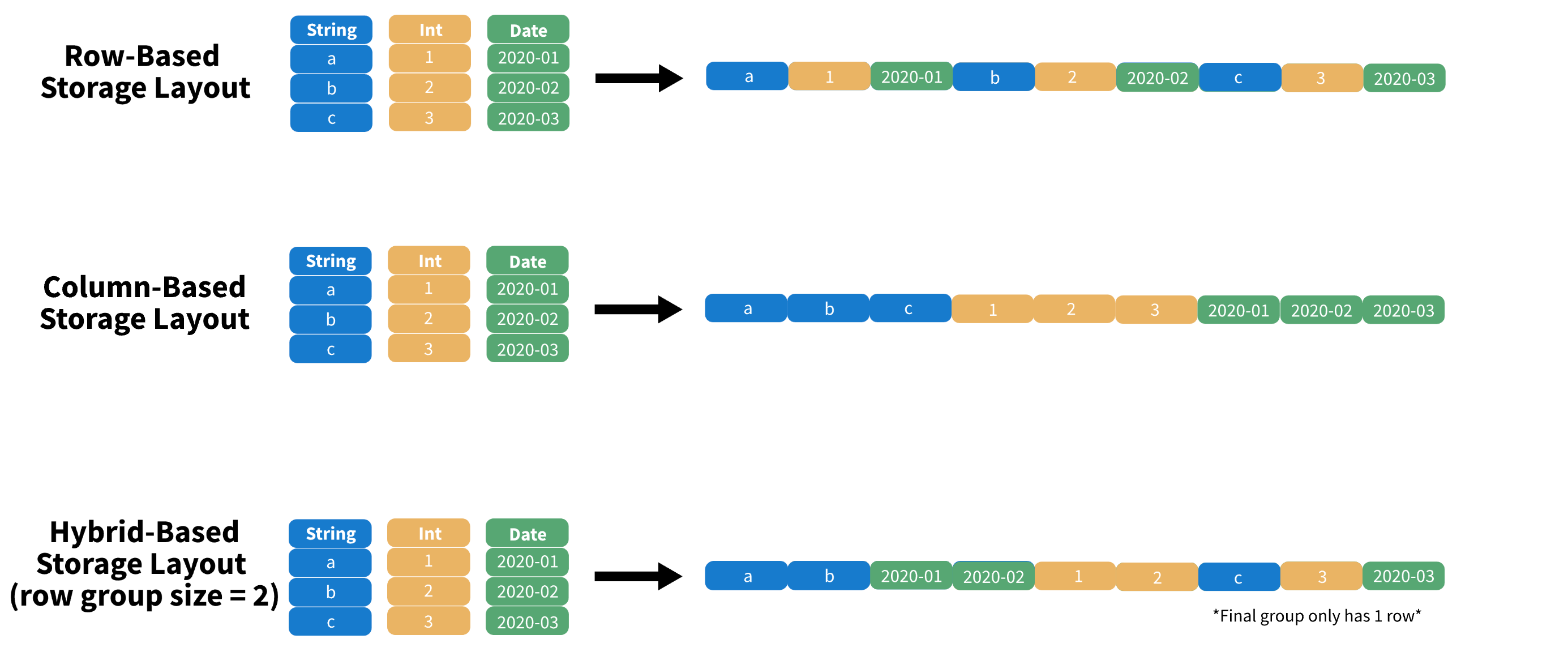
- With row-based storage, we “hop” from one data type to another with each subsequent read
1→"jeff"→300→date(2023)
- With columnar storage, sequential blocks have same data type! \(\leadsto\) Run-Length Encoding (RLE)
- 2 million consecutive records with
date(2023)becomes(date(2023), 2000000)🤯 - 10 years of records: 20 million bytes → 20 bytes
Dream No More… Parquet Files Have Arrived
Hybrid Columnar/Row-Based Storage
DuckDB Demo
References
Berk, Michael. 2022. “Demystifying the Parquet File Format.” Towards Data Science. August 16, 2022.