Code
import polars as pl
import itables
enron_meta_pl = pl.read_parquet('enron_meta.parquet')
itables.show(enron_meta_pl)| Loading ITables v2.8.1 from the internet... (need help?) |
As mentioned in class during Week 7, this dataset was actually the first dataset brainstormed among the instructors for pre-approved Midterm \(\rightarrow\) Final Project purposes! We mention this here because, it represents a rare instance where we can actually analyze real data from a real company’s backend DB, rather than having to simulate it (as in the healthcare example).
The most widely-studied version of this dataset contains about 500,000 emails, released to the public as part of the litigation over Enron’s prosecution for accounting fraud by the US Federal Bureau of Investigation and Federal Energy Regulatory Commission.
As mentioned on the main datasets page, however, the goal here is not to analyze the Enron emails as such, but to imagine how you would handle new email data continuously streaming into an OLTP database with the same structure! In other words, your analysis of this data should be generalizable to other organizations with significantly fewer (or significantly more) employees.
Your task here takes inspiration from a 2015 analysis of the Enron corpus which discovered a set of NLP-based features that could be extracted from the text of the emails which, in turn, predicted with high accuracy both the gender and the level in an organizational chart of the email-writers. Even within a single 3-email thread, for example, features of language usage already start to emerge, as shown in Figure 1. These individual-thread inferences can then be aggregated over the hundreds of thousands of available emails to obtain detailed information about the communicative “culture” within an organization.
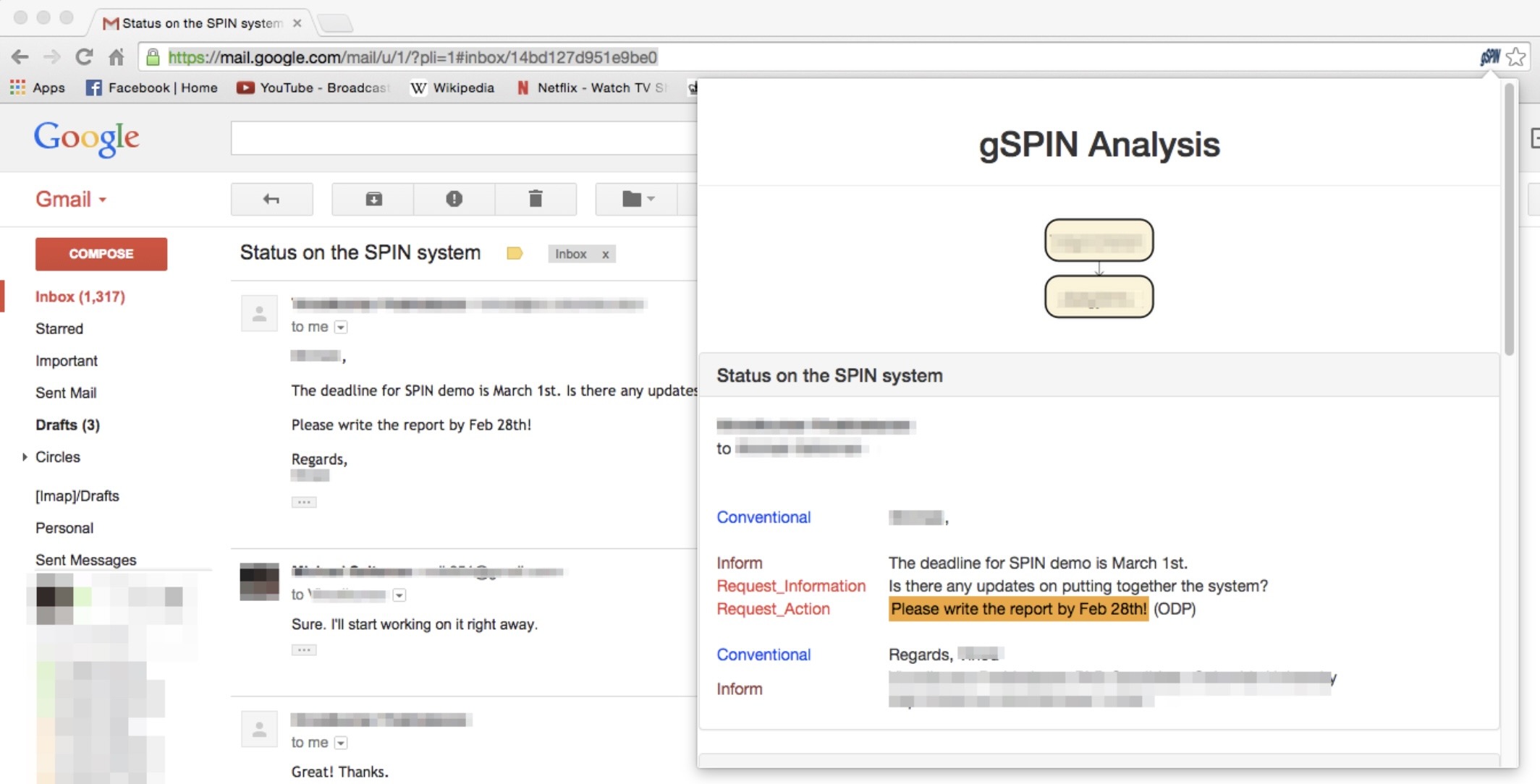
You have been hired as a data scientist at an organization (which was impressed by your big data and cloud computing skills!) which has recently recived concerning reports from HR about an overall “toxic culture” when it comes to day-to-day interactions between genders and between higher- and lower-level employees. The organization has heard about how Google’s “Project Oxygen” reduced tensions between managers and employees, and is hoping you can use their email corpus to identify issues and achieve a similar outcome.
As you can read in Prabhakaran (2015), there are straightforward NLP-based features that can be extracted at the end of the data-processing pipeline, measuring aspects of the emails like politeness or gendered adjectives (“bossy” vs. “confident”). Your job here is thus to tackle the infrastructural challenges that lay “along the way” to these measurable outcomes:
Here, the OLTP structure used by the organization to record email information is similar to the logs of any other SMTP email server: Sort of like the examples of HTTP and Linux logs we saw in class during Week 1, each event or record represents information about an incoming or outgoing email. The following records illustrate the types of issues which may arise in bringing these records from “raw” OLTP form into an OLAP infrastructure.
First, this email (randomly sampled from the folder containing Kenneth Lay’s inbox) illustrates a “well-formatted” email, where fields like Date, Subject, From, and To, as well as the plaintext email body, would be easy to parse and enter into an OLAP framework (such as a data warehouse or data lake):
lay-k/inbox/28.txt
Message-ID: <6755745.1075845190138.JavaMail.evans@thyme>
Date: Thu, 24 May 2001 19:05:02 -0700 (PDT)
From: jhduncan@aol.com
To: klay@enron.com
Subject: The coming trip on May 29th
Mime-Version: 1.0
Content-Type: text/plain; charset=us-ascii
Content-Transfer-Encoding: 7bit
X-From: JHDUNCAN@aol.com@ENRON <IMCEANOTES-JHDUNCAN+40aol+2Ecom+40ENRON@ENRON.com>
X-To: klay@enron.com
X-cc:
X-bcc:
X-Folder: \Lay, Kenneth\Lay, Kenneth\Inbox
X-Origin: LAY-K
X-FileName: Lay, Kenneth.pst

Ken,
With your permission, Harry and I will plan to bring our golf clubs on the
airplane on Tuesday.  I plan to buy one of those little traveling golf bags
(very small) and carry only about 5 or 6 of my clubs with me. Mick may or may
not do the same.  It's your call if this is OK for the plane and whether or
not you bring yours.  This way when Harry and I get to betting on the game,
we will not have the quality of the rent clubs as an excuse for the quality
of our game.
John
However, this email from the same inbox shows that the body of the email may not be so easy to parse, as the Unix operating system running Enron’s email server condensed certain emails by line-breaking the text with = characters:
lay-k/inbox/1810.txt
Message-ID: <28698423.1075862888104.JavaMail.evans@thyme>
Date: Tue, 13 Nov 2001 11:38:01 -0800 (PST)
From: w..pereira@enron.com
To: kenneth.lay@enron.com
Subject: ENRON - A Study in How So Few Could Screw So Many
Mime-Version: 1.0
Content-Type: text/plain; charset=us-ascii
Content-Transfer-Encoding: quoted-printable
X-From: Pereira, Susan W. </O=ENRON/OU=NA/CN=RECIPIENTS/CN=SPEREIR>
X-To: Lay, Kenneth </O=ENRON/OU=NA/CN=RECIPIENTS/CN=Klay>
X-cc:
X-bcc:
X-Folder: \KLAY (Non-Privileged)\Lay, Kenneth\Inbox
X-Origin: Lay-K
X-FileName: KLAY (Non-Privileged).pst

Mr. Lay-

After reading the news of your $60,000,000 to $80,000,000 payout, I am disg=
usted and appalled all over again.  Unfortunately, that's a daily occurrenc=
e.=20

I have been employed with Enron since May of 1993, when Enron purchased LRC=
.  I was very skeptical of Enron back then and was unsure of my future with=
 the company.  As time went on, I got more comfortable with the Enron way a=
nd learned how to survive and even be a little successful here.  I became a=
 believer in the things Enron could accomplish, a champion of our hard-nose=
d, driven executives (at least some of them).  I bought Enron stock and hel=
d on to those valuable options.

It is painfully obvious to me and my coworkers, as well as the rest of the =
industry and Houston, that Enron's executives knew that there were skeleton=
s in the closet and began cashing in ahead of this freefall.  The employees=
 and the rest of the world were fed a bunch of half-truths and mystery mumb=
o-jumbo.  There should be an accounting for this behavior.  You and your co=
horts have ruined so many lives.  Think about that while you're spending yo=
ur millions.....


Susan Pereira
ENA Gas Trader
A second challenge is that, while this is the smallest email in Lay’s inbox by filesize, it turns out to be that small because it just references an attachment (pressrelease.doc) that your OLTP \(\leadsto\) OLAP pipeline would need to handle:
lay-k/inbox/348.txt
Message-ID: <13397155.1075852806479.JavaMail.evans@thyme>
Date: Fri, 19 Oct 2001 09:56:04 -0700 (PDT)
From: abalaban@aei.org
Subject: NAI National Survey Finds Strong Support for Israel
Mime-Version: 1.0
Content-Type: text/plain; charset=us-ascii
Content-Transfer-Encoding: 7bit
X-From: "Alanna Balaban" <abalaban@aei.org>@ENRON
X-To: undisclosed-recipients:;@ENRON
X-cc:
X-bcc:
X-Folder: \KLAY (Non-Privileged)\Inbox
X-Origin: Lay-K
X-FileName: KLAY (Non-Privileged).pst

 - pressrelease.doc
As a final example, this email sampled from a different employee’s inbox shows how the email addresses in the .txt files are not always well-formed – here, the first entry in the To field is e-mail <.arm@enron.com>, followed by the actual employee email (jeff.dasovich@enron.com):
dasovich-j/inbox/898.txt
Message-ID: <7208739.1075859209244.JavaMail.evans@thyme>
Date: Tue, 20 Nov 2001 09:14:49 -0800 (PST)
From: aaron.thomas@aesmail.com
To: e-mail <.arm@enron.com>, jeff.dasovich@enron.com
Subject: FW: IMPORTANT ! !
Mime-Version: 1.0
Content-Type: text/plain; charset=us-ascii
Content-Transfer-Encoding: quoted-printable
X-From: Aaron Thomas <aaron.thomas@aesmail.com>
X-To: Arm (E-mail) <arm@electric.com>, Dasovich, Jeff </O=ENRON/OU=NA/CN=RECIPIENTS/CN=JDASOVIC>
X-cc:
X-bcc:
X-Folder: \Jeff_Dasovich_Jan2002\Dasovich, Jeff\Inbox
X-Origin: Dasovich-J
X-FileName: jdasovic (Non-Privileged).pst

How do folks feel about a call on this subject today.  Say around 2 PM Paci=
fic.
=20
If this works for folks, lets use my dial-in number
=20
888.621.9536
PC *3957889*
=20
Aaron
=20
=20
As part of handling these email records, the following metadata file collects the names of each “Person of Interest” (POI) during the fraud hearings, including the list of emails found in the corpus for each POI:
import polars as pl
import itables

enron_meta_pl = pl.read_parquet('enron_meta.parquet')
itables.show(enron_meta_pl)| Loading ITables v2.8.1 from the internet... (need help?) |
Note that, although it is not the most efficient way to store the person-to-email mappings, the Parquet format does support typed Lists, as we can see by calling Polars’ read_parquet_schema() function on the metadata file displayed above:
import polars as pl

pl.read_parquet_schema('enron_meta.parquet')
Schema([('name', String),
('last', String),
('first', String),
('emails', List(String)),
('verdict', String),
('source', String)])