Week 9: BST Iteration, Functional Programming, and the RSA Algorithm

DSAN 5500: Data Structures, Objects, and Algorithms in Python

Jeff Jacobs

jj1088@georgetown.edu

Thursday, March 12, 2026

Schedule

Today’s Planned Schedule:

Start End Topic
Lecture 6:30pm 6:50pm Key Concepts →
6:50pm 7:00pm Execution Graphs →
7:00pm 7:15pm Deployments (Preview) →
7:15pm 8:00pm Lab Part 1 →
Break! 8:00pm 8:10pm
8:10pm 9:00pm Lab Part 2 →

Back to BSTs

  • For HW2, we provide you with an InventoryItem class
  • Two instance variables: item_name and price
  • Equivalence relations:
    • __eq__(other), __ne__(other)
  • Ordering relations:
    • __lt__(other), __le__(other), __gt__(other), __ge__(other)
  • Bonus: __repr__() and __str__()

Node Traversal: Computational Tree-Climbing

LLs \(\rightarrow\) BSTs: The Hard Part

  • When we were working with LinkedLists, we could access all items by just “looping through”, from one element to the next, printing as we go along.
  • But… for a BinarySearchTree, since our structure can now branch as we traverse it… How do we “loop through” a BST?
  • Two fundamentally different ways to traverse every node in our BST
  • “Opposites” of each other, so that one is often extremely efficient and the other extremely inefficient for a given task
  • Your job as a data scientist is to think carefully about which one is more efficient for a given goal!

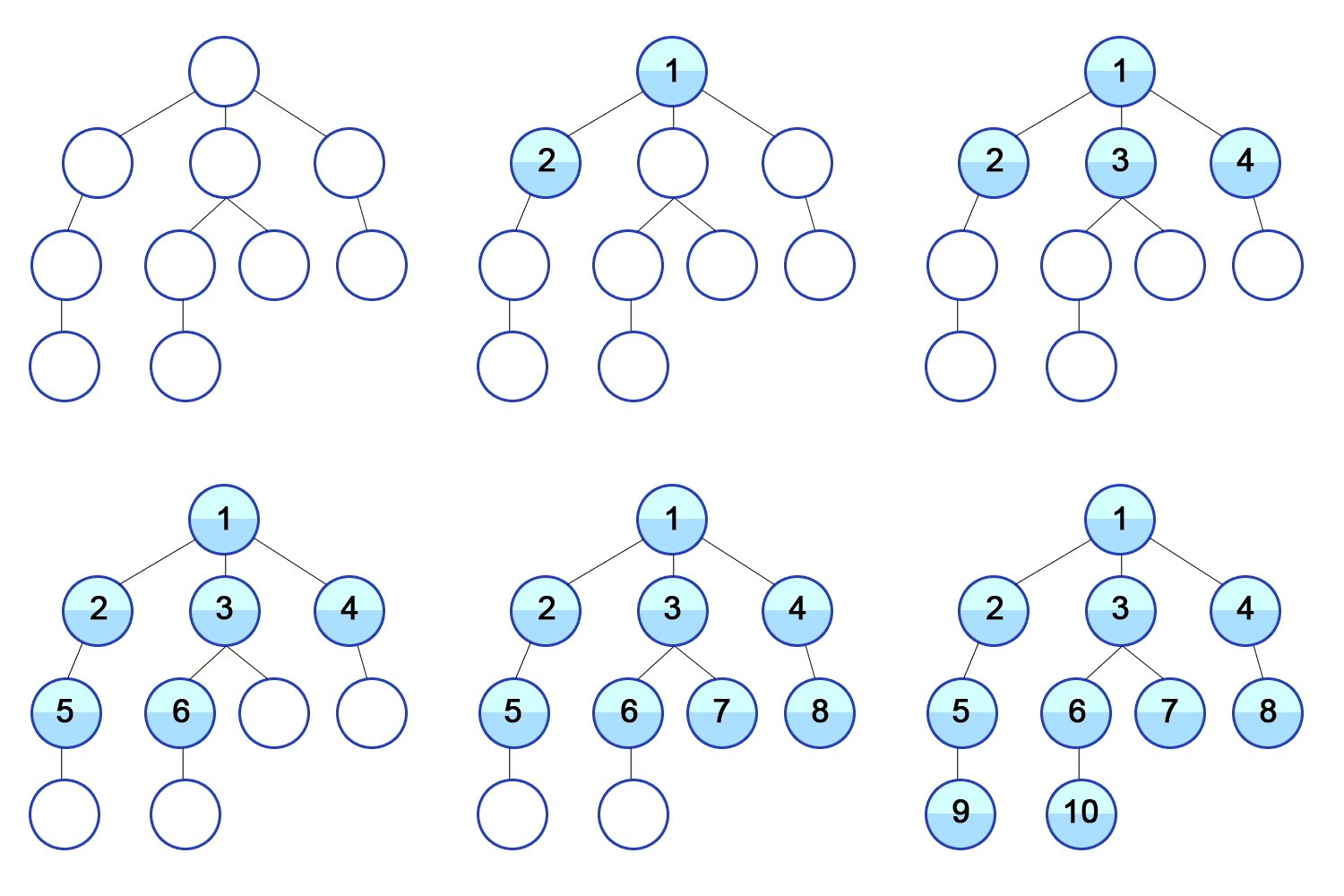
Two Ways to Traverse: IRL Version

  • Imagine we’re trying to learn about a topic \(\tau\) using Wikipedia, so we find its article \(\tau_0\)
  • There are two “extremes” in terms of strategies we could follow for learning, given the contents of the article as well as the links it contains to other articles

Depth-First Search (DFS)

  • Open \(\tau_0\) and start reading it; When we encounter a link we always click it and immediately start reading the new article.
  • If we hit an article with no links (or a dead end/broken link), we finish reading it and click the back button, picking up where we left off in the previous article. When we reach the end of \(\tau_0\), we’re done!

Breadth-First Search (BFS)

  • Bookmark \(\tau_0\) in a folder called “Level 0 Articles”; open and start reading it
  • When we encounter a link, we put it in a “Level 1 Articles” folder, but continue reading \(\tau_0\) until we reach the end.
  • We then open all “Level 1 Articles” in new tabs, placing links we encounter in these articles into a “Level 2 Articles” folder, that we only start reading once all “Level 1 Articles” are read
  • We continue like this, reading “Level 3 Articles” once we’re done with “Level 2 Articles”, “Level 4 Articles” once we’re done with “Level 3 Articles”, and so on. (Can you see a sense in which this is the “opposite” of DFS?)
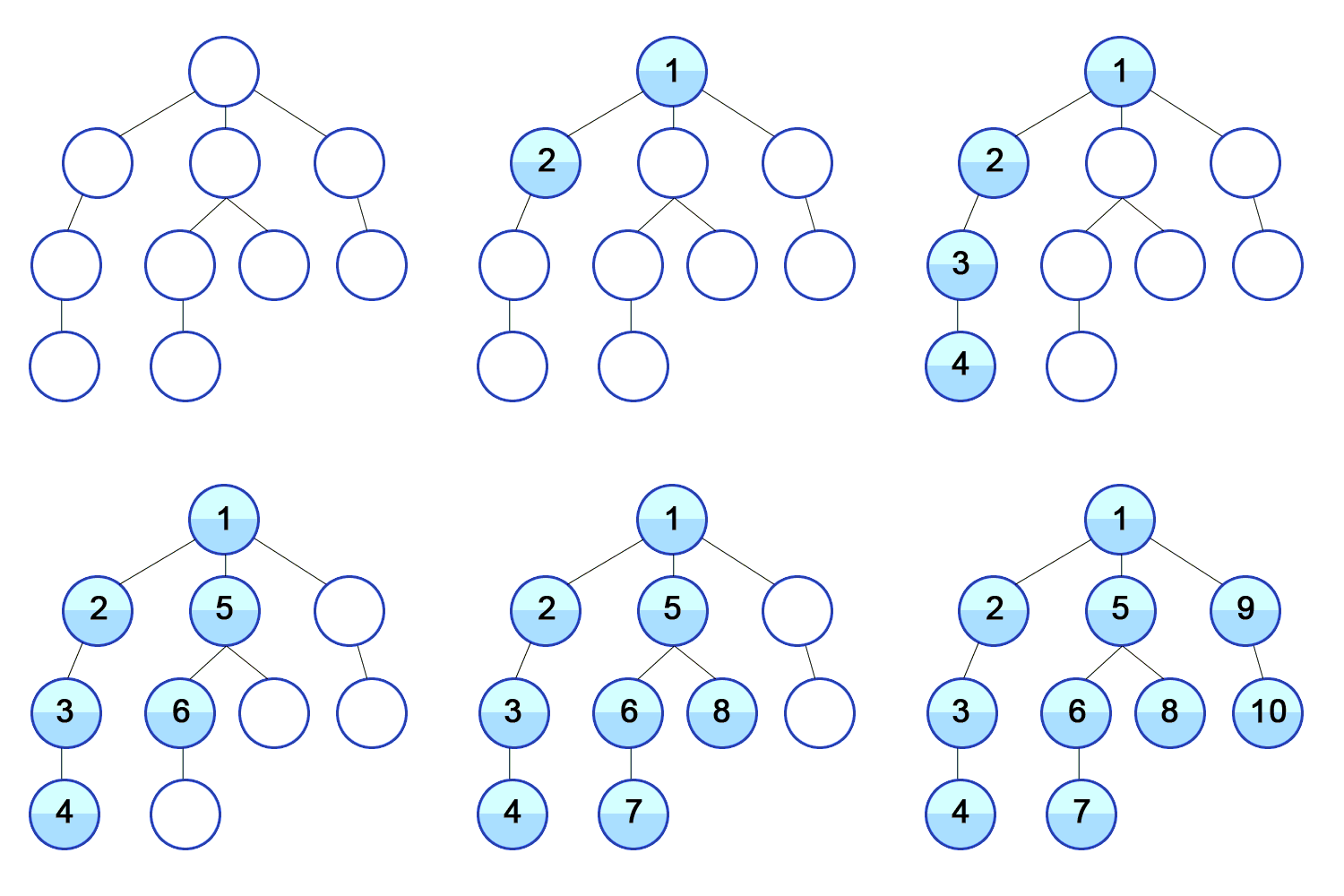
Two Ways to Traverse: Picture Version

Code
from hw2 import LinkedList, InventoryItem, BinarySearchTree, NodeProcessor, IterAlgorithm
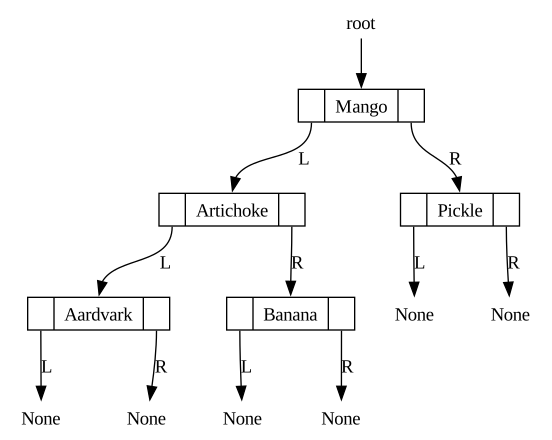
bst = BinarySearchTree()
item1 = InventoryItem('Mango', 50)
bst.add(item1)
item2 = InventoryItem('Pickle', 60)
bst.add(item2)
item3 = InventoryItem('Artichoke', 55)
bst.add(item3)
item5 = InventoryItem('Banana', 123)
bst.add(item5)
item6 = InventoryItem('Aardvark', 11)
bst.add(item6)
HTML(visualize(bst))

Code
print("DFS:")
dfs_processor = NodeProcessor(IterAlgorithm.DEPTH_FIRST)
#print(type(dfs_processor.node_container))
dfs_processor.iterate_over(bst)

print("\nBFS:")
bfs_processor = NodeProcessor(IterAlgorithm.BREADTH_FIRST)
#print(type(bfs_processor.node_container))
bfs_processor.iterate_over(bst)
DFS:
InventoryItem[item_name=Mango,price=50]
InventoryItem[item_name=Pickle,price=60]
InventoryItem[item_name=Artichoke,price=55]
InventoryItem[item_name=Banana,price=123]
InventoryItem[item_name=Aardvark,price=11]

BFS:
InventoryItem[item_name=Mango,price=50]
InventoryItem[item_name=Artichoke,price=55]
InventoryItem[item_name=Pickle,price=60]
InventoryItem[item_name=Aardvark,price=11]
InventoryItem[item_name=Banana,price=123]

Two Ways to Traverse: In-Words Version

  1. Depth-First Search (DFS): With this approach, we iterate through the BST by always taking the left child as the “next” child until we hit a leaf node (which means, we cannot follow this left-child pointer any longer, since a leaf node does not have a left child or a right child!), and only at that point do we back up and take the right children we skipped.
  2. Breadth-First Search (BFS): This is the “opposite” of DFS in the sense that we traverse the tree level-by-level, never moving to the next level of the tree until we’re sure that we have visited every node on the current level.

Two Ways to Traverse: Animated Version

Depth-First Search (from Wikimedia Commons)

Breadth-First Search (from Wikimedia Commons)

Two Ways to Traverse: Underlying Data Structures Version

  • Now that you have some intuition, you may be thinking that they might require very different code to implement 🤔

  • This is where mathematical-formal linkage between the two becomes helpful!

  • It turns out (and a full-on algorithmic theory course makes you prove) that

  • Depth-First Search can be accomplished by processing nodes in an order determined by adding each to a stack, while

  • Breadth-First Search can be accomplished by processing nodes in an order determined by adding each to a queue!

  • \(\implies\) Literally identical code, “pulling out” the word stack and replacing it with the word queue within your code (or vice-versa).

  • With Software Engineer Hat on, you’ll see this as a job for an abstraction layer!

Two Ways to Traverse: HW2 Version

  • You’ll make a class called NodeProcessor, with a single iterate_over(tree) function
  • This function—without any changes in the code or even any if statements!—will be capable of both DFS and BFS
  • It will take in a ThingContainer (could be a stack or a queue, you won’t know which), which has two functions:
    • put_new_thing_in(new_thing)
    • take_existing_thing_out()

Three Animals in the DFS Species

DFS Procedure Algorithm
Pre-Order Traversal 1. Print node
2. Traverse left subtree
3. Traverse right subtree
In-Order Traversal 🧐‼️ 1. Traverse left subtree
2. Print node
3. Traverse right subtree
Post-Order Traversal 1. Traverse left subtree
2. Traverse right subtree
3. Print node

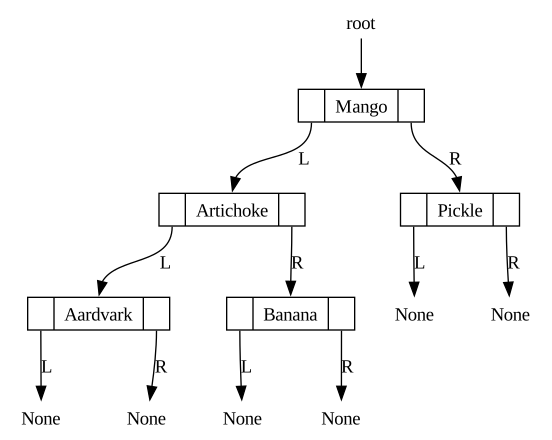
The Three Animals Traverse our Inventory Tree

Code
visualize(bst)

Final Notes for HW3

  • The last part challenges you to ask: why stop at a hash based on just the first letter of the key?
  • We could just as easily use the first two letters:
  • h('AA') = 0, h('AB') = 1, …, h('AZ') = 25,
  • h('BA') = 26, h('BB') = 27, …, h('BZ') = 51,
  • h('CA') = 52, …, h('ZZ') = 675.
  • You will see how this gets us even closer to the elusive \(O(1)\)! And we could get even closer with three letters, four letters, … 🤔🤔🤔

Functional Programming (FP)

Functions vs. Functionals

  • You may have noticed: map() and reduce() are “meta-functions”: functions that take other functions as inputs
def add_5(num):
  return num + 5
add_5(10)
15
def apply_twice(fn, arg):
  return fn(fn(arg))
apply_twice(add_5, 10)
20
  • In Python, functions can be used as vars (Hence lambda):
add_5 = lambda num: num + 5
apply_twice(add_5, 10)
20
  • This relates to a whole paradigm, “functional programming”! We will use it to approach encryption

Train Your Brain for Functional Approach \(\implies\) Master Debugging!

When a program doesn’t work, each function is an interface point where you can check that the data are correct. You can look at the intermediate inputs and outputs to quickly isolate the function that’s responsible for a bug.
(from Python’s “Functional Programming HowTo”)

Code \(\rightarrow\) Pipelines \(\rightarrow\) Debuggable Pipelines

  • Scenario: Run code, check the output, and… it’s wrong 😵 what do you do?
  • Usual approach: Read lines one-by-one, figuring out what they do, seeing if something pops out that seems wrong; adding comments like # Convert to lowercase
  • Easy case: found typo in punctuation removal code. Fix the error, add comment like # Remove punctuation

    Rule 1 of FP: transform these comments into function names

  • Hard case: Something in load_text() modifies a variable that later on breaks remove_punct() (Called a side-effect)

    Rule 2 of FP: NO SIDE-EFFECTS!

G input in.txt load_text load_text (Verb) input->load_text lowercase lowercase (Verb) load_text->lowercase 🧐 ✅ remove_punct remove_punct (Verb) lowercase->remove_punct 🧐 ✅ remove_stopwords remove_stopwords (Verb) remove_punct->remove_stopwords 🧐 ❌❗️ output out.txt remove_stopwords->output

(Does this way of diagramming a program look familiar?)

  • With side effects: ❌ \(\implies\) issue is somewhere earlier in the chain 😩🏃‍♂️
  • No side effects: ❌ \(\implies\) issue must be in remove_punct()!!! 😎 ⏱️ = 💰

If It’s So Useful, Why Doesn’t Everyone Do It?

  • Trapped in imperative (sequential) coding mindset: Path dependency / QWERTY
  • Reason we need to start thinking like this is: it’s 1000x harder to debug parallel code! So we need to be less ad hoc in how we write+debug, from here on out! 🙇‍♂️🙏

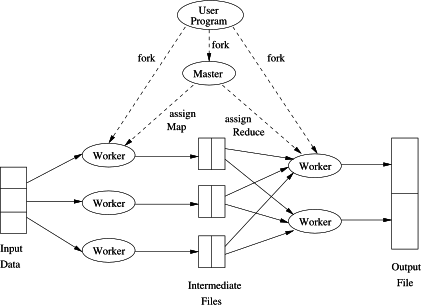
From Leskovec, Rajaraman, and Ullman (2014)

Cryptographic Algorithms

  • RSA
  • Elliptic-Curve Cryptography

The RSA Algorithm

The RSA public-key cryptosystem relies on the dramatic difference between the ease of finding large prime numbers and the difficulty of factoring the product of two large prime numbers (Cormen et al. 2001, sec. 31.7)

Bob encrypts \(M\) using Alice’s public key \(P_A\) and transmits the result \(C = P_A(M)\) over a communication channel to Alice. An eavesdropper who captures \(C\) gains no info about \(M\). Alice decrypts \(C\) using her secret key to obtain the original message: \(M = S_A(C)\)

Task 1: Encrypting a Message

  • Public Keys \(P_A\) and Secret Keys \(S_A\) are inverses:

\[ \begin{aligned} M &= S_A(P_A(M)) \\ M &= P_A(S_A(M)) \end{aligned} \]

  • Alice, and only Alice, is able to compute the function \(S_ A(\cdot)\) in any practical amount of time!
  • Bob \(\overset{M}{\rightarrow}\) Alice: Bob computes \(C = P_A(M)\) and sends \(C\) to Alice; Alice obtains \(M\) via \(S_A(C) = S_A(P_A(M)) = M\)

Task 2: Signing a Message!

  • Alice computes her digital signature \(\sigma = S_A(M')\), then sends the pair \((M', \sigma)\) \(\rightarrow\) Bob
  • When Bob receives \((M', \sigma)\), he verifies that it originated from Alice by using Alice’s public key to check \(M' = P_A(\sigma)\)

So How Do \(P_A\) and \(S_A\) Work?

  • Pick two big prime numbers \(p\) and \(q\), compute \(n = pq\)
  • Pick a small odd int \(e\) relatively prime to \((p-1)(q-1)\)
  • Find \(d\) such that \(de \equiv 1\text{ mod }{n}\)
  • Your public key is \(P = (e,n)\)
  • Your secret key is \(S = (d,n)\)
  • Encrypt: \(P(M) = M^e \text{ mod }{n}\); Decrypt: \(S(C) = C^d \text{ mod }{n}\)
  • Works because \(P(S(M)) = S(P(M)) = M^{ed} \overset{\small{*}}{=} M\)

Why Algorithmic Complexity Matters Here!

The security of the RSA cryptosystem rests in large part on the difficulty of factoring large integers.

If an adversary can factor the modulus \(n\) in a public key, they can derive the secret key from the public key, using the knowledge of the factors \(p\) and \(q\) in the same way that the creator of the public key used them.

Therefore, if factoring large integers is easy, then breaking the RSA cryptosystem is easy.

The converse statement, that if factoring large integers is hard, then breaking RSA is hard, is unproven (\(P \overset{\smash{\small{?}}}{\small{=}} NP\))

References

Cormen, Thomas H., Charles E. Leiserson, Ronald L. Rivest, and Clifford Stein. 2001. Introduction To Algorithms. MIT Press. https://books.google.com?id=NLngYyWFl_YC.
Leskovec, Jure, Anand Rajaraman, and Jeffrey David Ullman. 2014. Mining of Massive Datasets. Cambridge University Press. http://infolab.stanford.edu/~ullman/mmds/book.pdf.