Week 2: Linear Regression

DSAN 5300: Statistical Learning
Spring 2026, Georgetown University

Jeff Jacobs

jj1088@georgetown.edu

Monday, January 12, 2026

Schedule

Today’s Planned Schedule:

Start End Topic
Lecture 6:30pm 7:10pm Simple Linear Regression →
7:10pm 7:30pm Deriving the OLS Solution →
7:30pm 8:00pm Interpreting OLS Output →
Break! 8:00pm 8:10pm
8:10pm 8:30pm Quiz Review →
8:30pm 9:00pm Quiz 2!

Linear Regression

  • What happens to my dependent variable \(Y\) when my independent variable \(X\) increases by 1 unit?

  • Keep the goal in front of your mind:

    The Goal of Regression

    Find a line \(\widehat{y} = mx + b\) that best predicts \(Y\) for given values of \(X\)

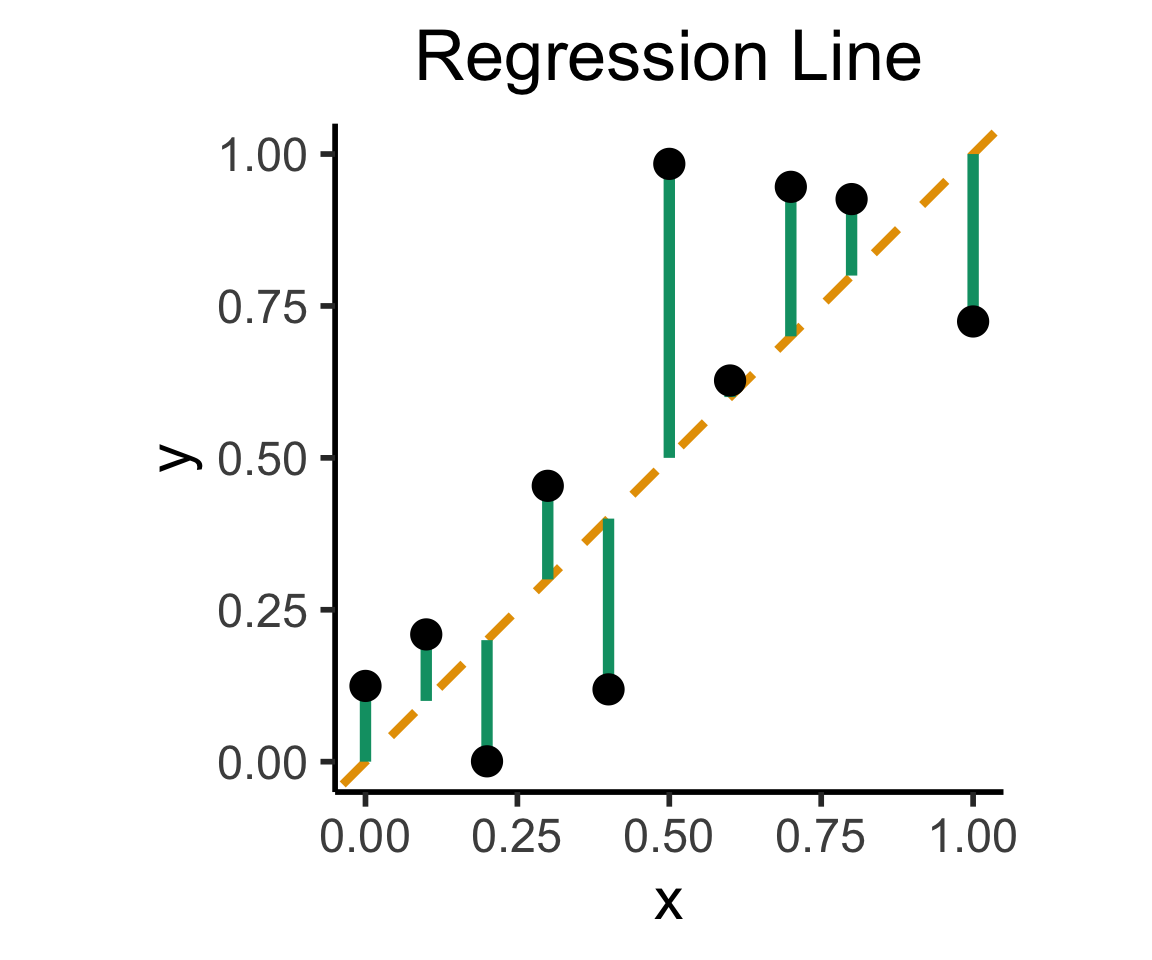
  • Sanity Note 1: \(\Rightarrow\) measuring error via vertical distance from line
  • Sanity Note 2: \(\Rightarrow\) modeling distribution of \(\boxed{Y \mid X}\), not \((X,Y)\)!
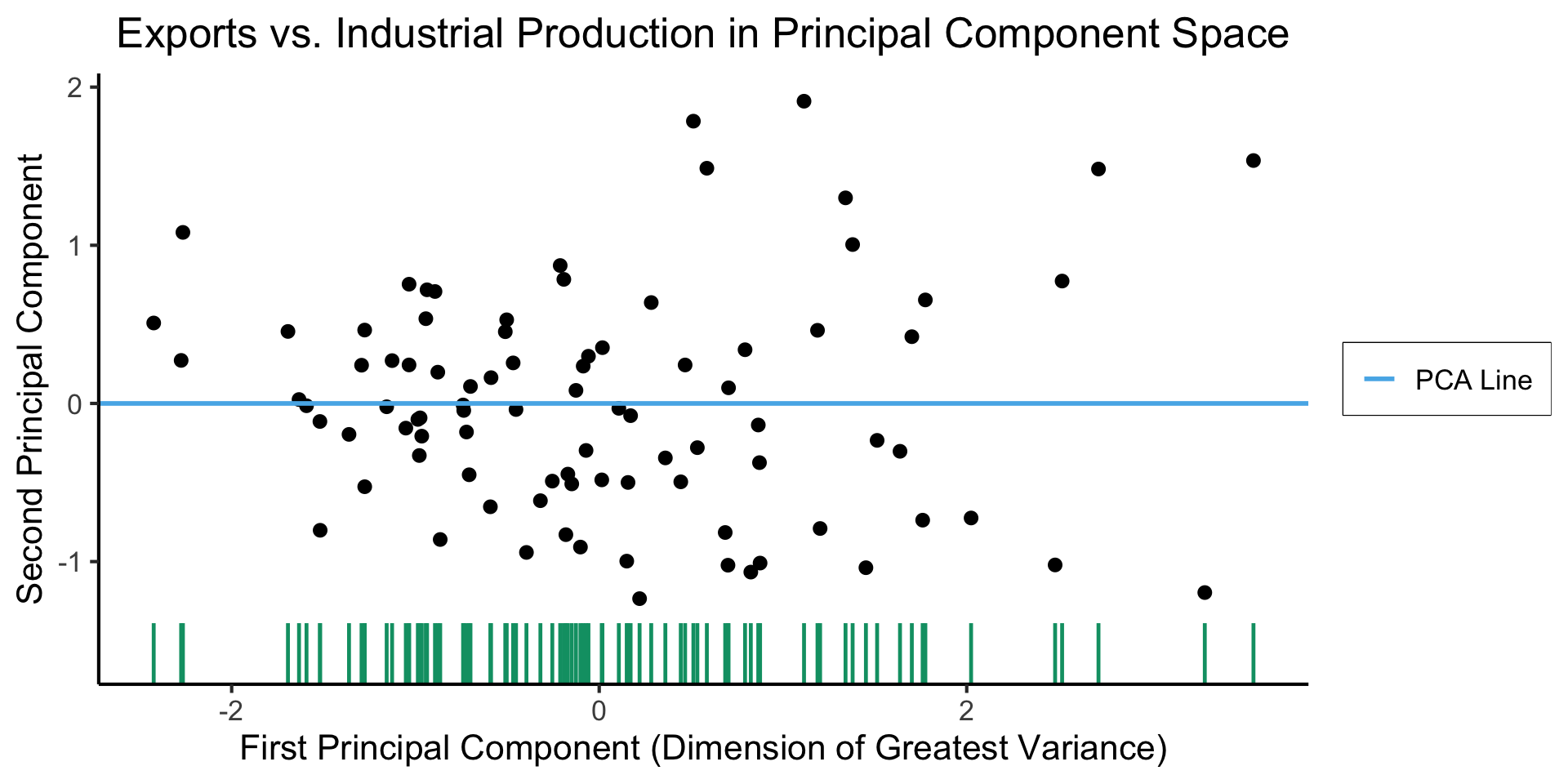
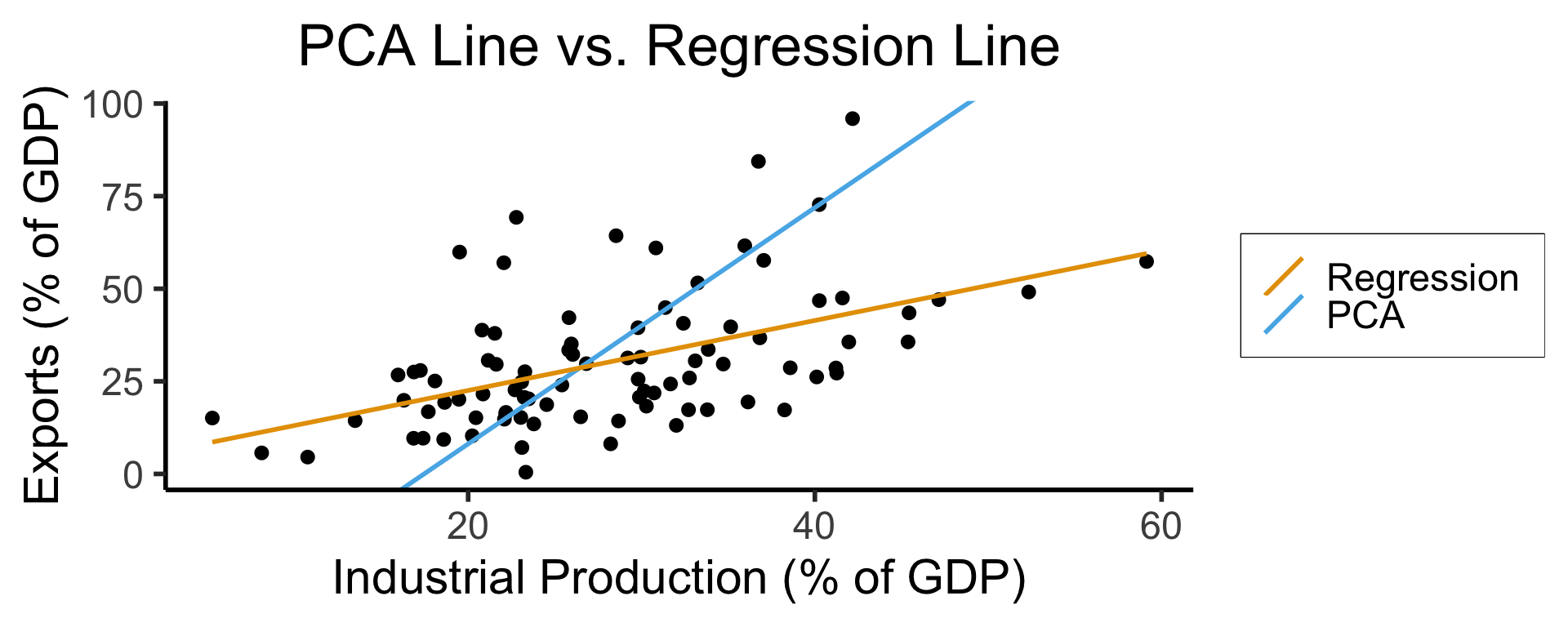
    • Predicting \(Y\) from \(X\) and \(X\) from \(Y\) \(\Rightarrow\) principal component line \(\neq\) regression!

How Do We Define “Best”?

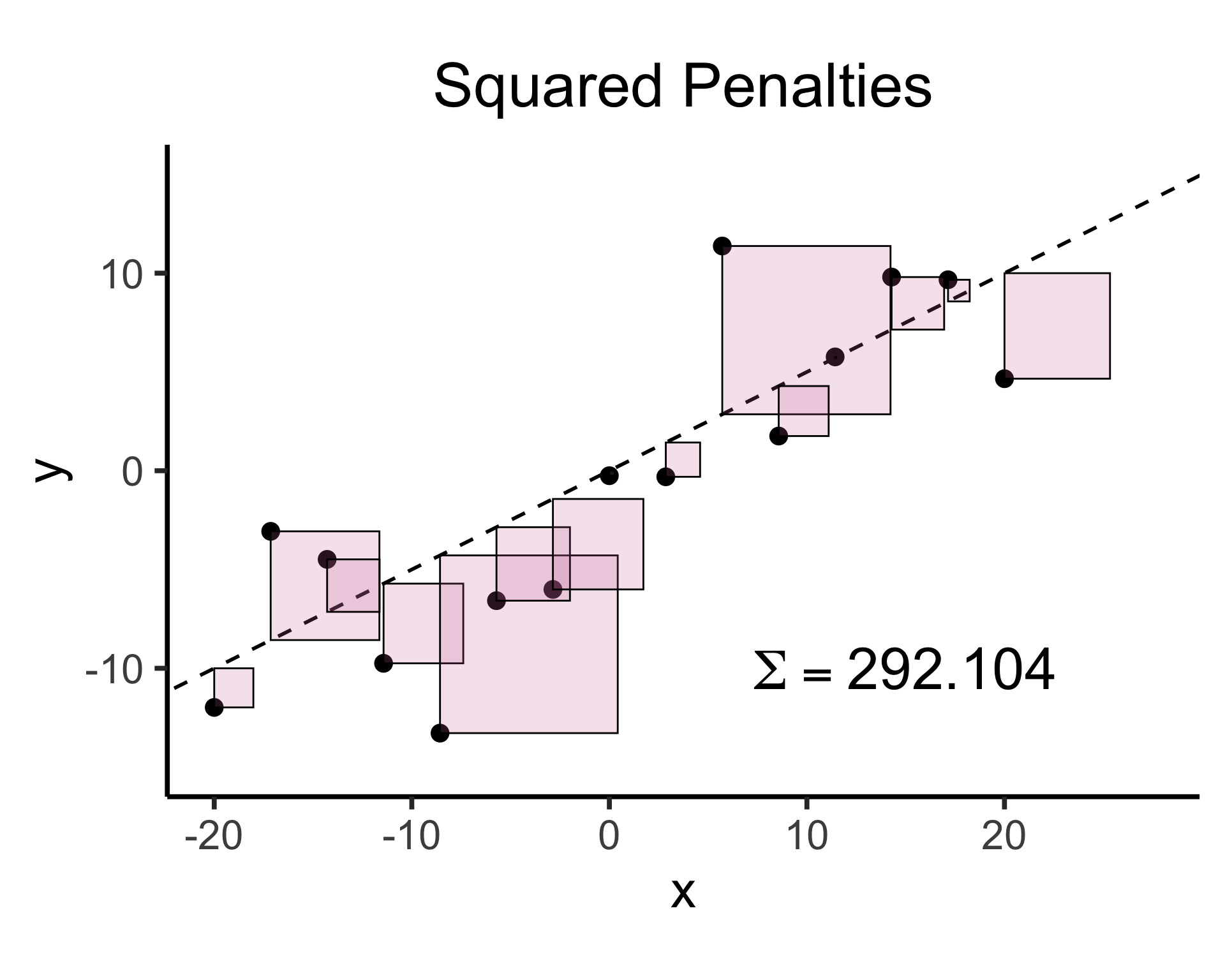
  • Intuitively, two different ways to measure how well a line fits the data:
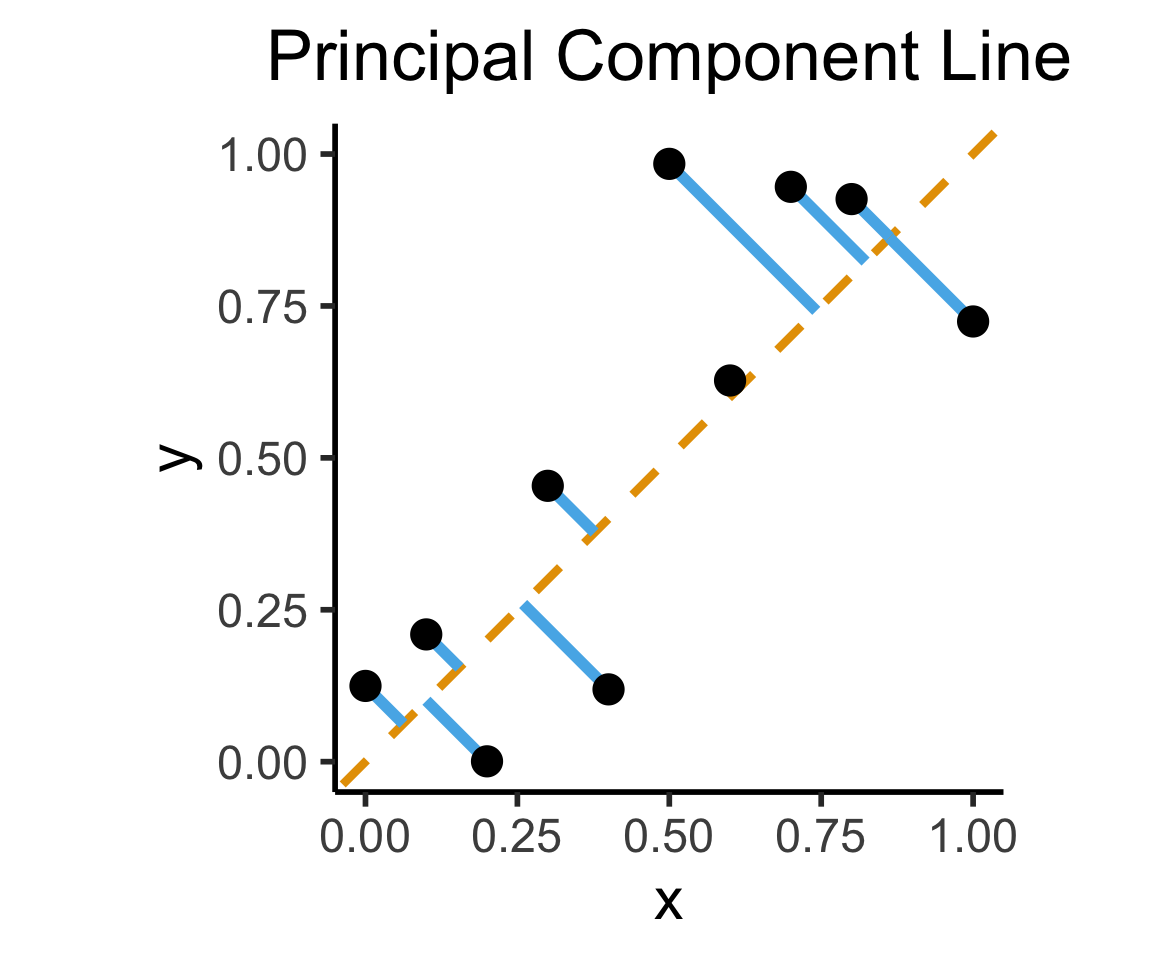
Figure 1: The line that minimizes blue distances does not predict \(Y\) as well as regression line, despite intuitive appeal!
Figure 2: The line that minimizes green distances optimally predicts \(Y\) from \(X\), in a mathematically-provable sense!

Principal Component Analysis

  • Principal Component Line can be used to project the data onto its dimension of highest variance (recap from 5000!)
  • More simply: PCA can discover meaningful axes in data (unsupervised learning / exploratory data analysis settings)

Create Your Own Dimension!

…And Use It for EDA
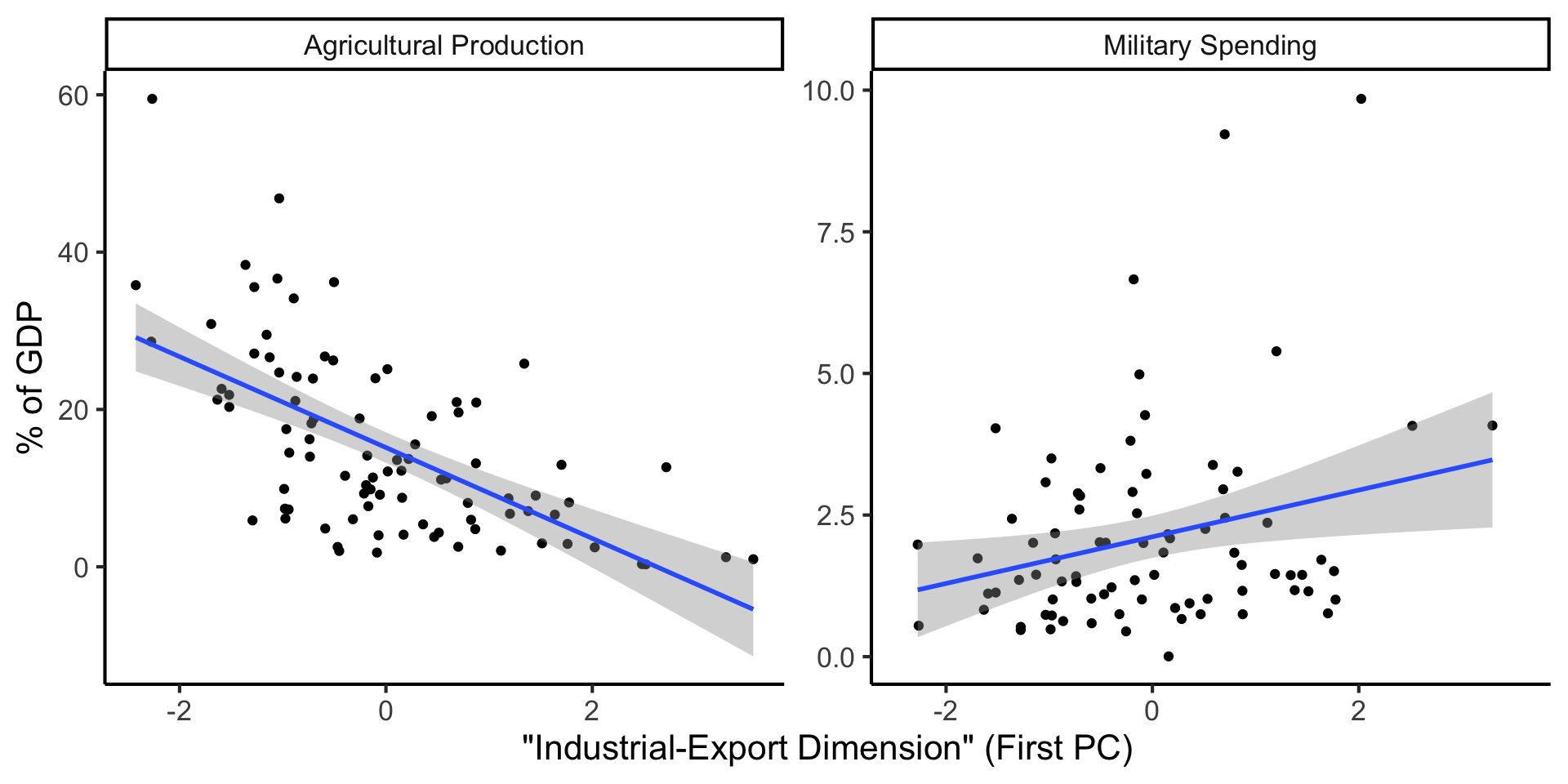
But in Our Case…

  • \(x\) and \(y\) dimensions already have meaning, and we have a hypothesis about effect of \(x\) on \(y\)!

The Regression Hypothesis \(\mathcal{H}_{\text{reg}}\)

Given data \((X, Y)\), we estimate \(\widehat{y} = \widehat{\beta}_0 + \widehat{\beta}_1x\), hypothesizing that:

  • Starting from \(y = \underbrace{\widehat{\beta}_0}_{\mathclap{\text{Intercept}}}\) when \(x = 0\),
  • An increase of \(x\) by 1 unit is associated with an increase of \(y\) by \(\underbrace{\widehat{\beta}_1}_{\mathclap{\text{Coefficient}}}\) units
  • We want to measure how well our line predicts \(y\) for any given \(x\) value \(\implies\) vertical distance from regression line

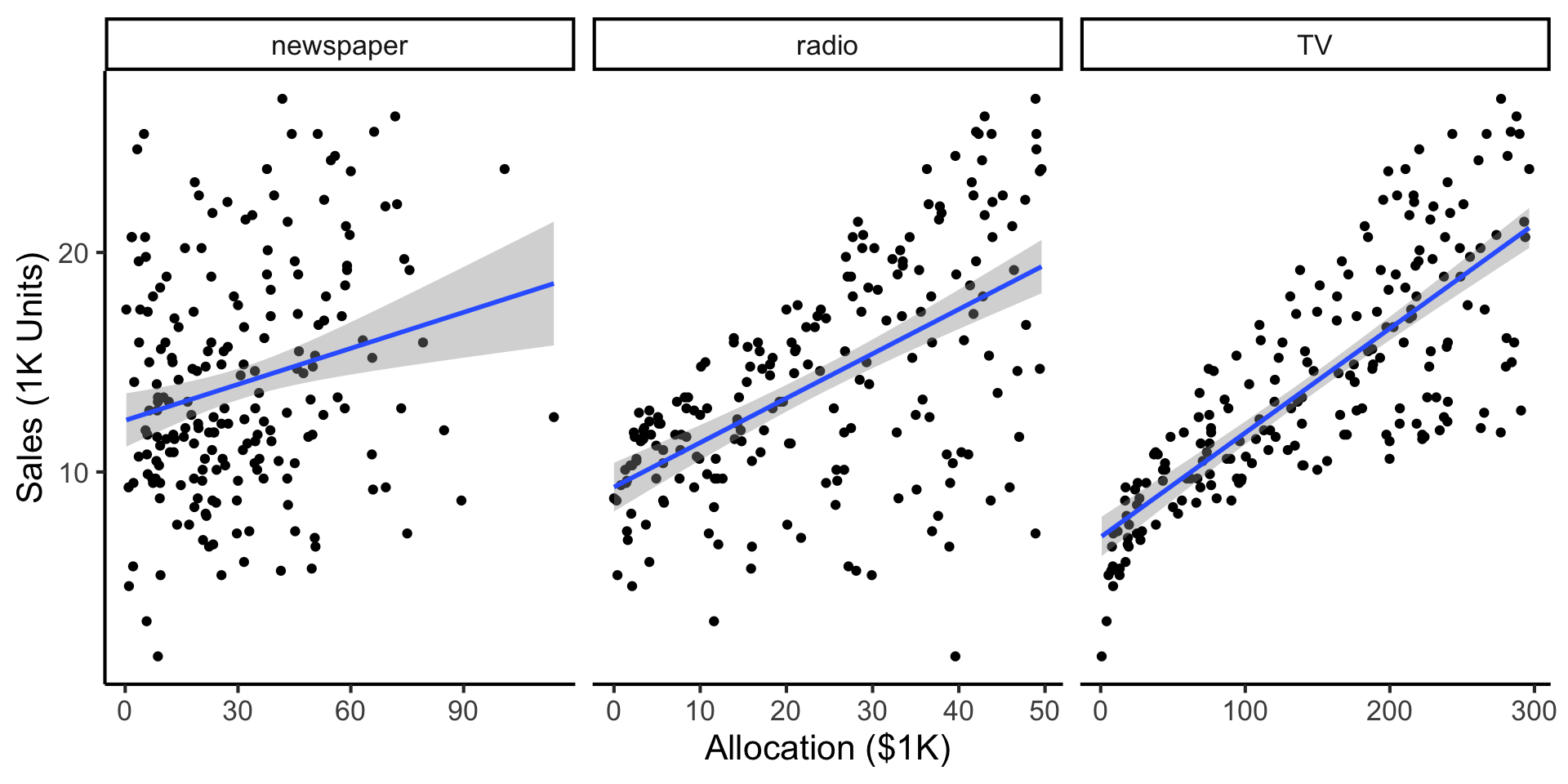
Example: Advertising Effects

  • Independent variable: $ put into advertisements; Dependent variable: Sales
  • Goal 1: Predict sales for a given allocation
  • Goal 2: Infer best allocation for a given advertising budget (more simply: a new $1K appears! Where should we invest it?)
Simple Linear Regression

  • For now, we treat Newspaper, Radio, TV advertising separately: how much do sales increase per $1 into [medium]? (Later we’ll consider them jointly: multiple regression)

Our model:

\[ Y = \underbrace{\param{\beta_0}}_{\mathclap{\text{Intercept}}} + \underbrace{\param{\beta_1}}_{\mathclap{\text{Slope}}}X + \varepsilon \]

…Generates predictions via:

\[ \widehat{y} = \underbrace{\widehat{\beta}_0}_{\mathclap{\small\begin{array}{c}\text{Estimated} \\[-5mm] \text{intercept}\end{array}}} ~+~ \underbrace{\widehat{\beta}_1}_{\mathclap{\small\begin{array}{c}\text{Estimated} \\[-4mm] \text{slope}\end{array}}}\cdot x \]

  • Note how these predictions will be wrong (unless the data is perfectly linear)
  • We’ve accounted for this in our model (by including \(\varepsilon\) term)!
  • But, we’d like to find estimates \(\widehat{\beta}_0\) and \(\widehat{\beta}_1\) that produce the “least wrong” predictions: motivates focus on residuals \(\widehat{\varepsilon}_i\)

\[ \widehat{\varepsilon}_i = \underbrace{y_i}_{\mathclap{\small\begin{array}{c}\text{Real} \\[-5mm] \text{label}\end{array}}} - \underbrace{\widehat{y}_i}_{\mathclap{\small\begin{array}{c}\text{Predicted} \\[-5mm] \text{label}\end{array}}} = \underbrace{y_i}_{\mathclap{\small\begin{array}{c}\text{Real} \\[-5mm] \text{label}\end{array}}} - \underbrace{ \left( \widehat{\beta}_0 + \widehat{\beta}_1 \cdot x \right) }_{\text{\small{Predicted label}}} \]

Least Squares: Minimizing Residuals

What can we optimize to ensure these residuals are as small as possible?
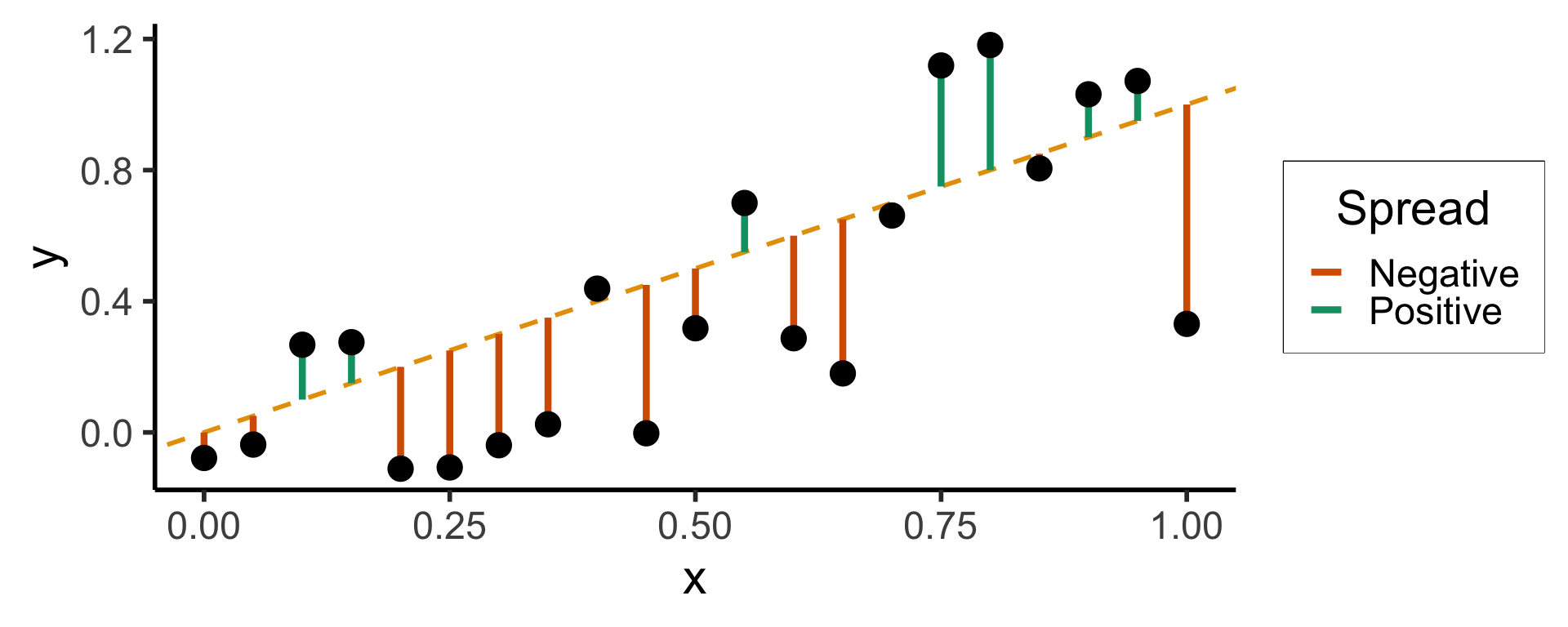
Sum?

0.0000000000

Sum of Squares?

3.8405017200

Sum of absolute vals?

7.6806094387

Sum?

0.0000000000

Sum of Squares?

1.9748635217

Sum of absolute vals?

5.5149697440

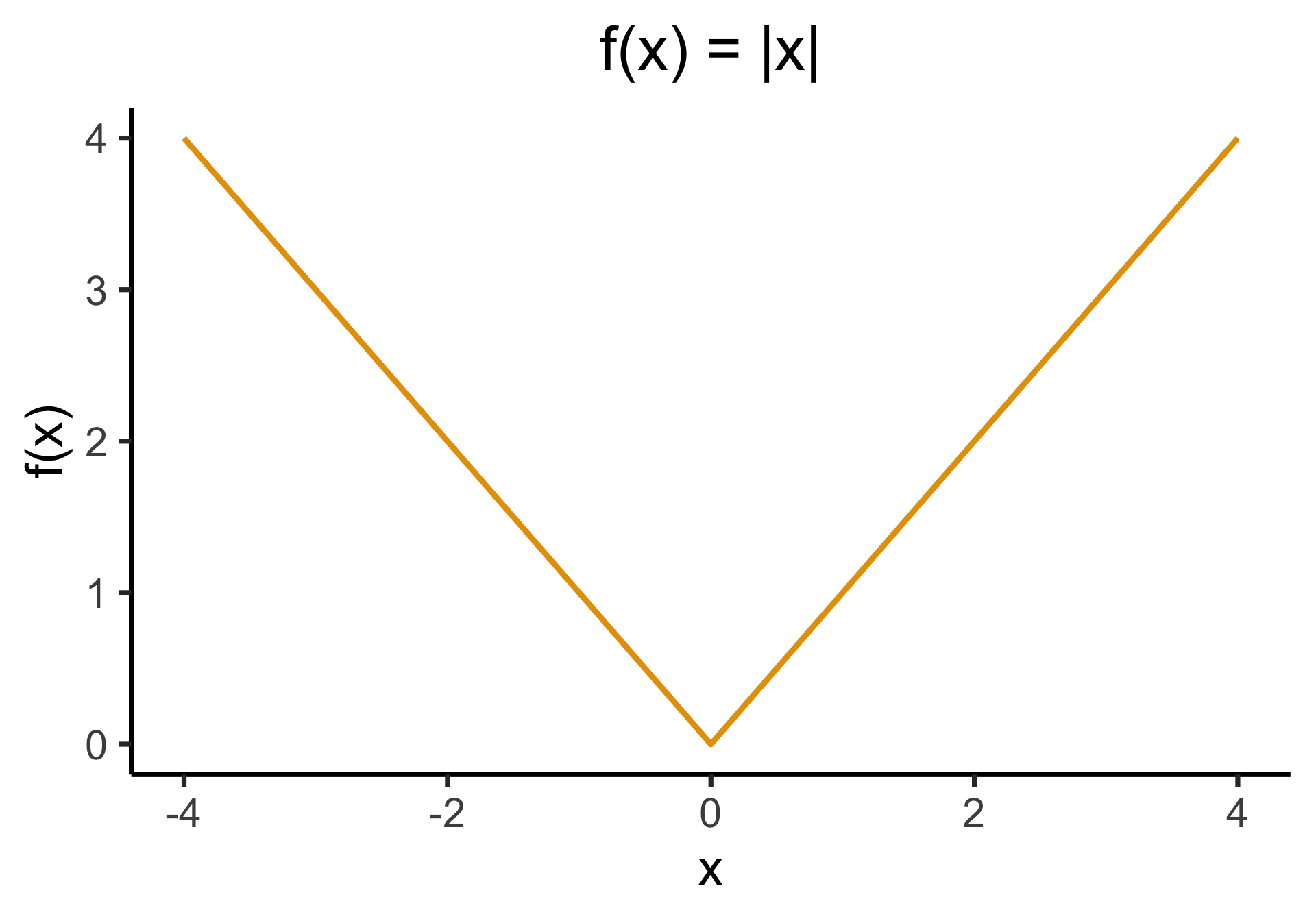
Why Not Absolute Value?

  • Two feasible ways to prevent positive and negative residuals cancelling out:
    • Absolute error \(\left|y - \widehat{y}\right|\) or squared error \(\left( y - \widehat{y} \right)^2\)
  • But remember: we’re aiming to minimize 👀 these residuals; ghost of calculus past 😱
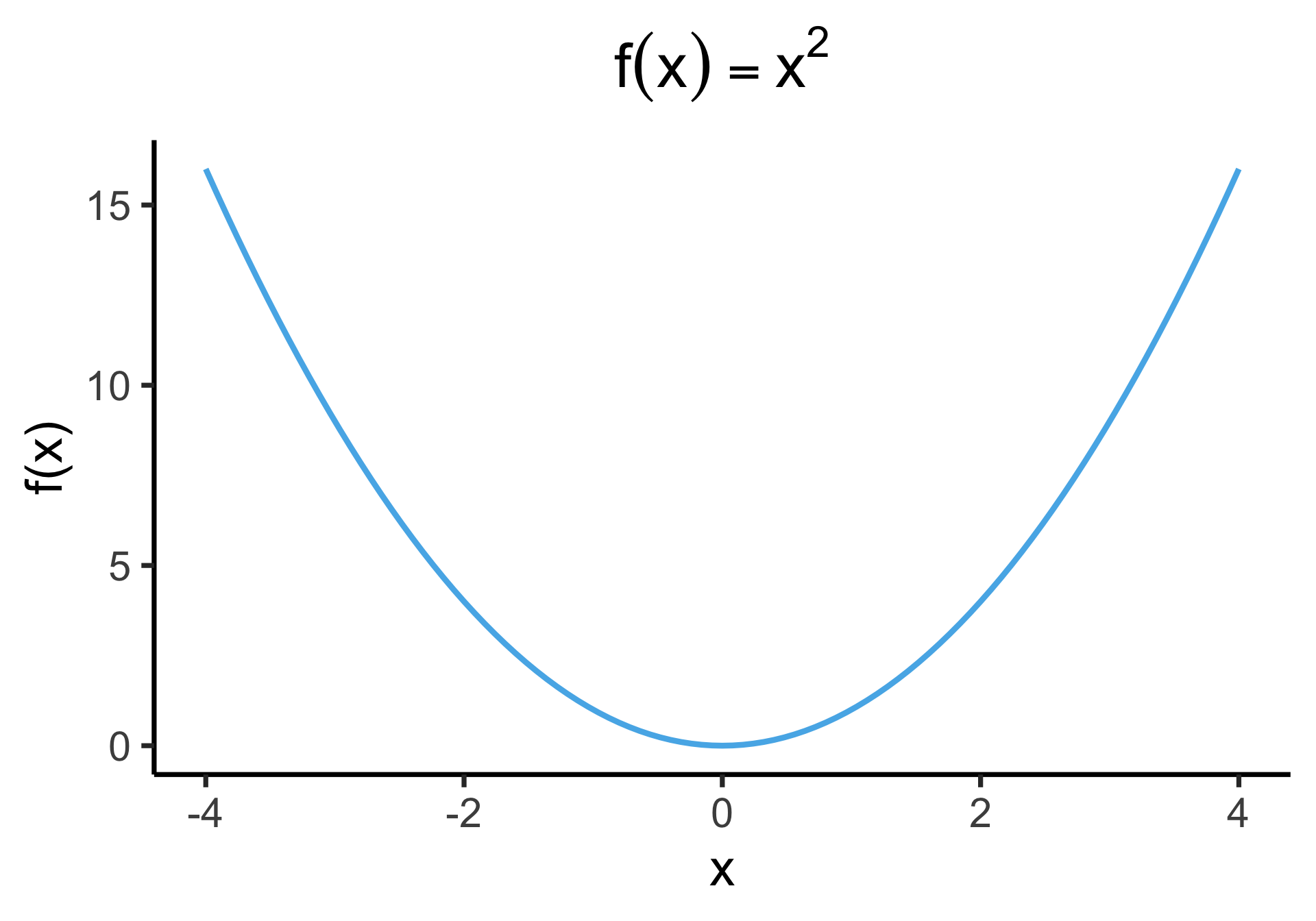
  • We minimize by taking derivatives… which one is differentiable everywhere?
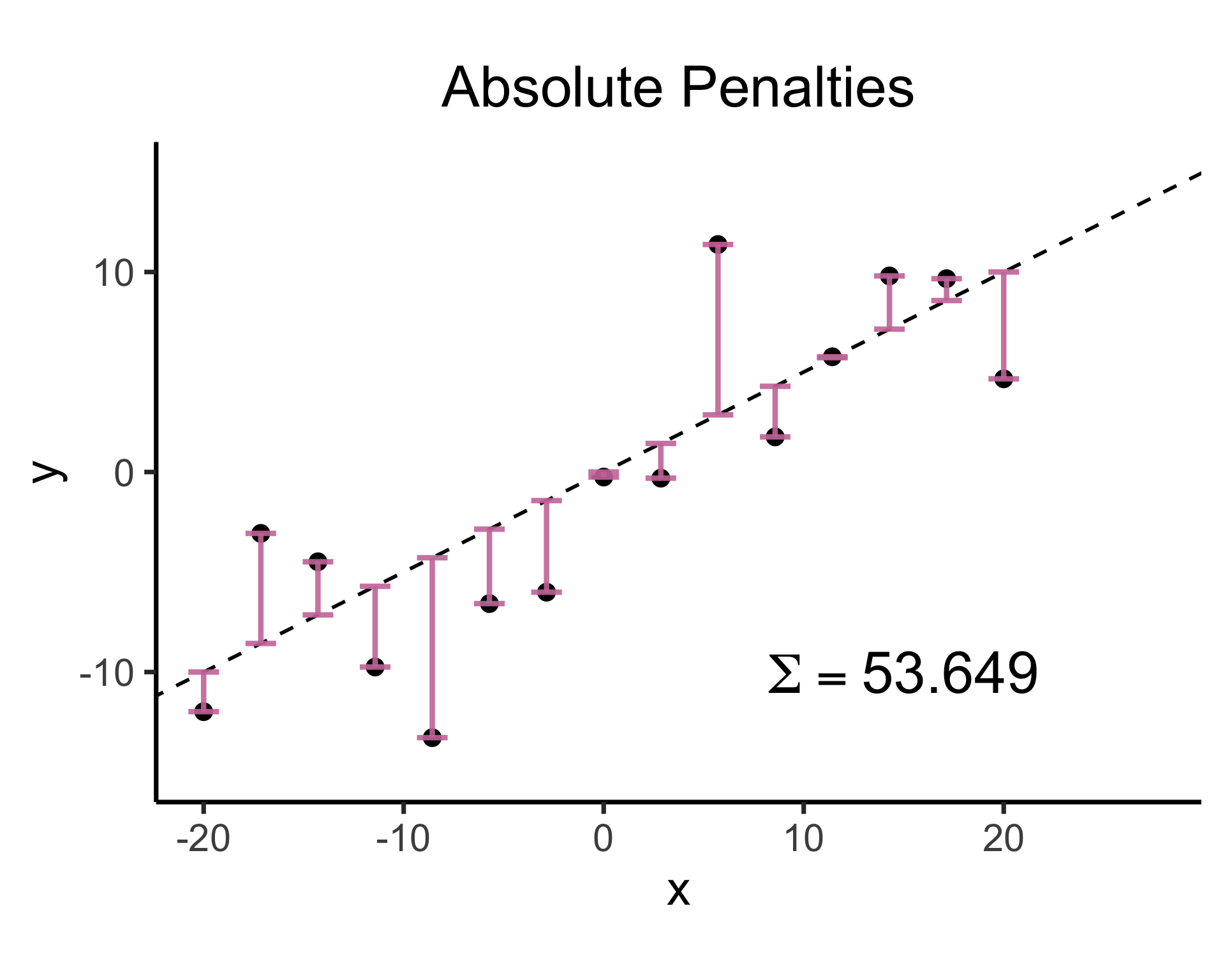
Outliers Penalized Quadratically

  • May feel arbitrary at first (we’re “forced” to use squared error because of calculus?)
  • It also has important consequences for “learnability” via gradient descent!
Key Features of Regression Line

  • Regression line is BLUE: Best Linear Unbiased Estimator
  • What exactly is it the “best” linear estimator of?

\[ \widehat{y} = \underbrace{\widehat{\beta}_0}_{\mathclap{\small\begin{array}{c}\text{Estimated} \\[-5mm] \text{intercept}\end{array}}} ~+~ \underbrace{\widehat{\beta}_1}_{\mathclap{\small\begin{array}{c}\text{Estimated} \\[-4mm] \text{slope}\end{array}}}\cdot x \]

is chosen so that

\[ \widehat{\theta} = \left(\widehat{\beta}_0, \widehat{\beta}_1\right) = \argmin_{\beta_0, \beta_1}\left[ \sum_{x_i \in X} \left(~~\overbrace{\widehat{y}(x_i)}^{\mathclap{\small\text{Predicted }y}} - \overbrace{\expect{Y \mid X = x_i}}^{\small \text{Avg. }y\text{ when }x = x_i}\right)^{2~} \right] \]

Where Did That \(\mathbb{E}[Y \mid X = x_i]\) Come From?

  • From our assumption that the irreducible errors \(\varepsilon_i\) are normally distributed \(\mathcal{N}(0, \sigma^2)\)
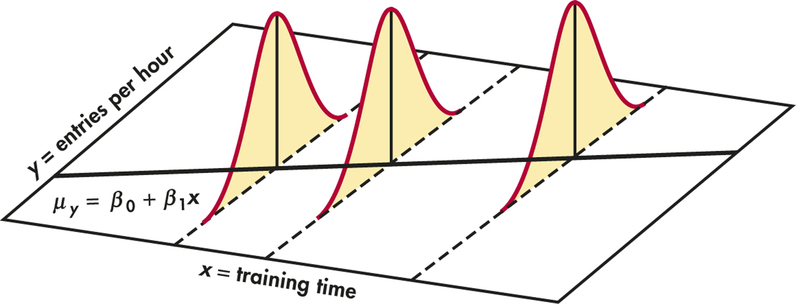
Image Source

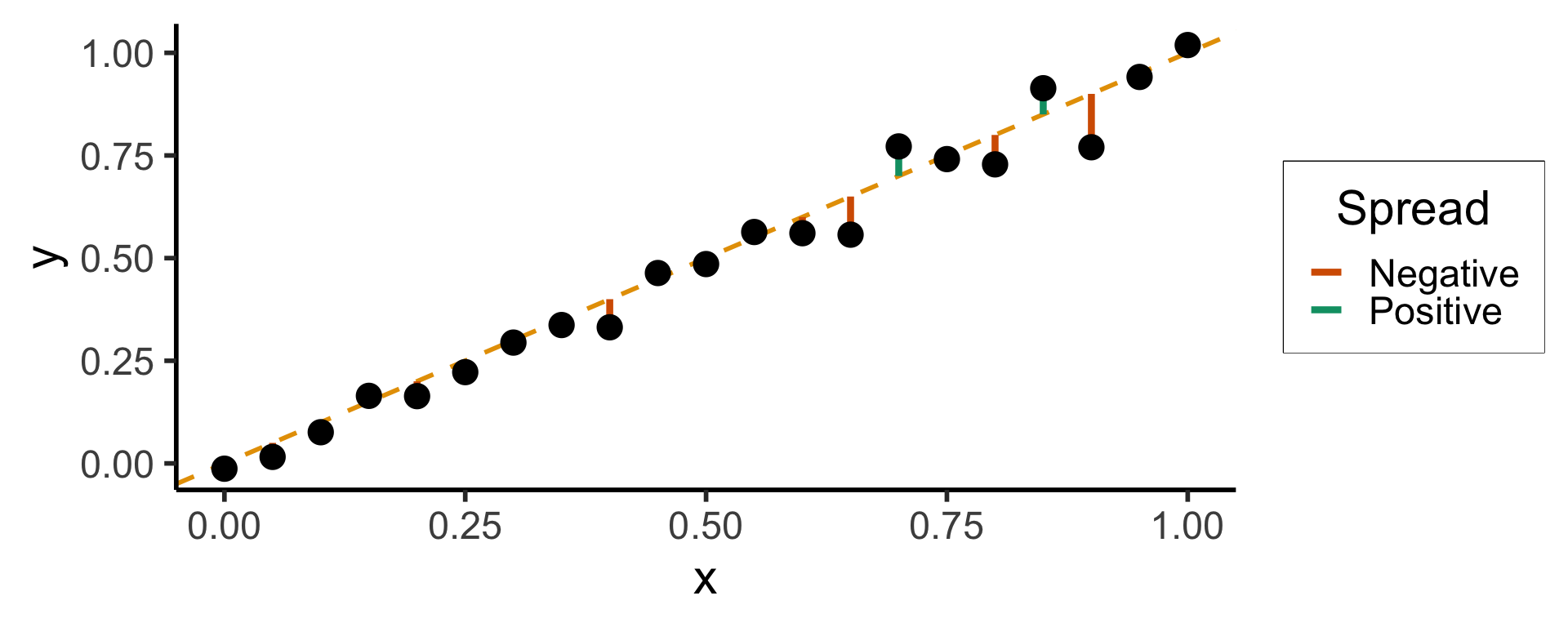
  • Kind of an immensely important point, since it gives us a hint for checking whether model assumptions hold: spread around the regression line should be \(\mathcal{N}(0, \sigma^2)\)

Heteroskedasticity

  • If spread increases or decreases for larger \(x\), for example, then \(\varepsilon \nsim \mathcal{N}(0, \sigma^2)\)
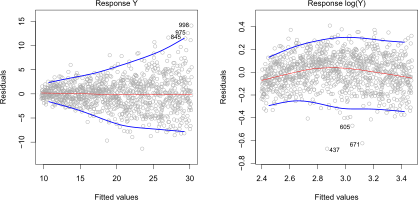
Figure 3.11 from James et al. (2023)

But… What About Other Types of Vars?

  • 5000: you saw nominal, ordinal, cardinal vars
  • 5100: you wrestled with discrete vs. continuous RVs
  • Good News #1: Regression can handle all these types+more!
  • Good News #2: Distinctions between classification and regression diminish as you learn fancier regression methods!
    • tldr: Predict continuous probabilities \(\Pr(Y) \in [0,1]\) (regression), then guess 1 if \(\Pr(Y) > 0.5\) (classification)
  • By end of 5300 you should have something on your toolbelt for handling most cases like “I want to do [regression / classification], but my data is [not cardinal+continuous]”

Deriving the Least Squares Estimate

A Sketch (HW is the Full Thing)

  • OLS for regression without intercept: Which line through origin best predicts \(Y\)?
  • (Good practice + reminder of how restricted linear models are!)

\[ Y = \beta_1 X + \varepsilon \]

Evaluating with Residuals

Now the Math

\[ \begin{align*} \beta_1^* = \overbrace{\argmin}^{\begin{array}{c} \text{\small{Find thing}} \\[-5mm] \text{\small{that minimizes}}\end{array}}_{\beta_1}\left[ \sum_{i=1}^{n}(y_i - \widehat{y}_i)^2 \right] = \argmin_{\beta_1}\left[ \sum_{i=1}^{n}(y_i - \beta_1x_i)^2 \right] \end{align*} \]

We can compute this derivative to obtain:

\[ \frac{\partial}{\partial\beta_1}\left[ \sum_{i=1}^{n}(\beta_1x_i - y_i)^2 \right] = \sum_{i=1}^{n}\frac{\partial}{\partial\beta_1}(\beta_1x_i - y_i)^2 = \sum_{i=1}^{n}2(\beta_1x_i - y_i)x_i \]

And our first-order condition means that:

\[ \sum_{i=1}^{n}2(\beta_1^*x_i - y_i)x_i = 0 \iff \beta_1^*\sum_{i=1}^{n}x_i^2 = \sum_{i=1}^{n}x_iy_i \iff \boxed{\beta_1^* = \frac{\sum_{i=1}^{n}x_iy_i}{\sum_{i=1}^{n}x_i^2}} \]

Doing Things With Regression

Regression: R vs. statsmodels

In (Base) R: lm()
Code
lin_model <- lm(sales ~ TV, data=ad_df)
summary(lin_model)

Call:
lm(formula = sales ~ TV, data = ad_df)

Residuals:
    Min      1Q  Median      3Q     Max 
-8.3860 -1.9545 -0.1913  2.0671  7.2124 

Coefficients:
            Estimate Std. Error t value Pr(>|t|)    
(Intercept) 7.032594   0.457843   15.36   <2e-16 ***
TV          0.047537   0.002691   17.67   <2e-16 ***
---
Signif. codes:  0 '***' 0.001 '**' 0.01 '*' 0.05 '.' 0.1 ' ' 1

Residual standard error: 3.259 on 198 degrees of freedom
Multiple R-squared:  0.6119,    Adjusted R-squared:  0.6099 
F-statistic: 312.1 on 1 and 198 DF,  p-value: < 2.2e-16

General syntax:

lm(
  dependent ~ independent + controls,
  data = my_df
)
In Python: smf.ols()
Code
import statsmodels.formula.api as smf
results = smf.ols("sales ~ TV", data=ad_df).fit()
print(results.summary(slim=True))
                            OLS Regression Results                            
==============================================================================
Dep. Variable:                  sales   R-squared:                       0.612
Model:                            OLS   Adj. R-squared:                  0.610
No. Observations:                 200   F-statistic:                     312.1
Covariance Type:            nonrobust   Prob (F-statistic):           1.47e-42
==============================================================================
                 coef    std err          t      P>|t|      [0.025      0.975]
------------------------------------------------------------------------------
Intercept      7.0326      0.458     15.360      0.000       6.130       7.935
TV             0.0475      0.003     17.668      0.000       0.042       0.053
==============================================================================

Notes:
[1] Standard Errors assume that the covariance matrix of the errors is correctly specified.

General syntax:

smf.ols(
  "dependent ~ independent + controls",
  data = my_df
)

Interpreting Output


Call:
lm(formula = military ~ industrial, data = gdp_df)

Residuals:
    Min      1Q  Median      3Q     Max 
-2.3354 -1.0997 -0.3870  0.6081  6.7508 

Coefficients:
            Estimate Std. Error t value Pr(>|t|)  
(Intercept)  0.61969    0.59526   1.041   0.3010  
industrial   0.05253    0.02019   2.602   0.0111 *
---
Signif. codes:  0 '***' 0.001 '**' 0.01 '*' 0.05 '.' 0.1 ' ' 1

Residual standard error: 1.671 on 79 degrees of freedom
  (8 observations deleted due to missingness)
Multiple R-squared:  0.07895,   Adjusted R-squared:  0.06729 
F-statistic: 6.771 on 1 and 79 DF,  p-value: 0.01106

Zooming In: Coefficients

Estimate Std. Error t value Pr(>|t|)
(Intercept) 0.61969 0.59526 1.041 0.3010
industrial 0.05253 0.02019 2.602 0.0111 *
\(\widehat{\beta}\) Uncertainty Test stat \(t\) How extreme is \(t\)? Signif. Level

\[ \widehat{y} \approx \class{cb1}{\overset{\beta_0}{\underset{\small \pm 0.595}{0.620}}} + \class{cb2}{\overset{\beta_1}{\underset{\small \pm 0.020}{0.053}}} \cdot x \]

Zooming In: Significance

Estimate Std. Error t value Pr(>|t|)
(Intercept) 0.61969 0.59526 1.041 0.3010
industrial 0.05253 0.02019 2.602 0.0111 *
\(\widehat{\beta}\) Uncertainty Test stat \(t\) How extreme is \(t\)? Signif. Level

The Residual Plot

Recall homoskedasticity assumption: Given our model

\[ y_i = \beta_0 + \beta_1x_i + \varepsilon_i \]

the errors \(\varepsilon_i\) should not vary systematically with \(i\)

Formally: \(\forall i \left[ \Var{\varepsilon_i} = \sigma^2 \right]\)

Q-Q Plot

  • If \((\widehat{y} - y) \sim \mathcal{N}(0, \sigma^2)\), points would lie on 45° line:

Multiple Linear Regression

  • Notation: \(x_{i,j}\) = value of independent variable \(j\) for person/observation \(i\)
  • \(M\) = total number of independent variables

\[ \widehat{y}_i = \beta_0 + \beta_1x_{i,1} + \beta_2x_{i,2} + \cdots + \beta_M x_{i,M} \]

  • \(\beta_j\) interpretation: a one-unit increase in \(x_{i,j}\) is associated with a \(\beta_j\) unit increase in \(y_i\), holding all other independent variables constant

Visualizing Multiple Linear Regression

(ISLR Fig 3.5): A pronounced non-linear relationship. Positive residuals (visible above the surface) tend to lie along the 45° line, where budgets are split evenly. Negative residuals (most not visible) tend to be away from this line, where budgets are more lopsided.

Interpreting MLR


Call:
lm(formula = sales ~ TV + radio + newspaper, data = ad_df)

Residuals:
    Min      1Q  Median      3Q     Max 
-8.8277 -0.8908  0.2418  1.1893  2.8292 

Coefficients:
             Estimate Std. Error t value Pr(>|t|)    
(Intercept)  2.938889   0.311908   9.422   <2e-16 ***
TV           0.045765   0.001395  32.809   <2e-16 ***
radio        0.188530   0.008611  21.893   <2e-16 ***
newspaper   -0.001037   0.005871  -0.177     0.86    
---
Signif. codes:  0 '***' 0.001 '**' 0.01 '*' 0.05 '.' 0.1 ' ' 1

Residual standard error: 1.686 on 196 degrees of freedom
Multiple R-squared:  0.8972,    Adjusted R-squared:  0.8956 
F-statistic: 570.3 on 3 and 196 DF,  p-value: < 2.2e-16

Holding radio and newspaper spending constant

  • An increase of $1K in spending on TV ads is associated with…
  • An increase in sales of 46 units

Holding TV and newspaper spending constant

  • An increase of $1K in spending on radio ads is associated with…
  • An increase in sales of 189 units

But Wait…

\[ \texttt{sales} = \overset{*}{\beta_0} + \overset{*}{\beta_1}\texttt{newspaper} \]

             Estimate Std. Error t value  Pr(>|t|)    
(Intercept) 12.351407   0.621420 19.8761 < 2.2e-16 ***
newspaper    0.054693   0.016576  3.2996  0.001148 ** 
---
Signif. codes:  0 '***' 0.001 '**' 0.01 '*' 0.05 '.' 0.1 ' ' 1

\[ \texttt{sales} = \overset{*}{\beta_0} + \overset{*}{\beta_1}\texttt{TV} + \overset{*}{\beta_2}\texttt{radio} + \overset{(~~)}{\beta_3}\texttt{paper} \]

              Estimate Std. Error t value Pr(>|t|)    
(Intercept)  2.9388894  0.3119082  9.4223   <2e-16 ***
TV           0.0457646  0.0013949 32.8086   <2e-16 ***
radio        0.1885300  0.0086112 21.8935   <2e-16 ***
newspaper   -0.0010375  0.0058710 -0.1767   0.8599    
---
Signif. codes:  0 '***' 0.001 '**' 0.01 '*' 0.05 '.' 0.1 ' ' 1
  • newspaper \(\overset{*}{\rightarrow}\) sales in SLR, but newspaper \(\overset{*}{\not\rightarrow}\) sales in MLR?
  • Correlations \(\Rightarrow\) MLR results can be drastically different from SLR results
  • This is a good thing! It’s how we’re able to control for confounding vars!

Correlations Among Features

Code
cor(ad_df |> select(-id))
                  TV      radio  newspaper     sales
TV        1.00000000 0.05480866 0.05664787 0.7822244
radio     0.05480866 1.00000000 0.35410375 0.5762226
newspaper 0.05664787 0.35410375 1.00000000 0.2282990
sales     0.78222442 0.57622257 0.22829903 1.0000000
  • Observe how \(\text{cor}(\texttt{radio}, \texttt{newspaper}) \approx 0.35\) (highest feat-feat correlation)
  • In markets where we spend more on radio our sales will tend to be higher…
  • Corr matrix \(\implies\) we spend more on newspaper in those same markets…
  • In SLR which only examines sales vs. newspaper, we (correctly!) observe that higher values of newspaper are associated with higher values of sales
  • In essence, newspaper advertising is a surrogate for radio advertising \(\implies\) in our SLR, newspaper “gets credit” for the association between radio and sales

Regression Superpower: Incorporating Categorical Vars

(Preview for next week)

\[ Y = \beta_0 + \beta_1 \times \texttt{income} \]

\[ \begin{align*} Y = &\beta_0 + \beta_1 \times \texttt{income} + \beta_2 \times \texttt{Student} \\ &+ \beta_3 \times (\texttt{Student} \times \texttt{Income}) \end{align*} \]

  • How does the \(\texttt{Student} \times \texttt{Income}\) term help?
  • Understanding this setup will open up a vast array of possibilities for regression 😎

Quiz Review

Objective Functions

“Fitting” a statistical model to data means minimizing some loss function that measures “how bad” our predictions are:

Optimization Problems: General Form

Find \(x^*\), the solution to

\[ \begin{align} \min_{x} ~ & f(x) &\text{(Objective function)} \\ \text{s.t. } ~ & g(x) = 0 &\text{(Constraints)} \end{align} \]

  • Earlier we were able to write \(x^* = \argmax_x{f(x)}\), since there were no constraints. Is there a way to write a formula like this with constraints?
  • Answer: Yes! Thx Giuseppe-Luigi Lagrangia = Joseph-Louis Lagrange:

\[ x^* = \argmax_{x,~\lambda}f(x) - \lambda[g(x)] \]

Example Problem

Example 1: Unconstrained Optimization

Find \(x^*\), the solution to

\[ \begin{align} \min_{x} ~ & f(x) = 3x^2 - x \\ \text{s.t. } ~ & \varnothing \end{align} \]

Our Plan

  • Compute the derivative \(f'(x) = \frac{\partial}{\partial x}f(x)\),
  • Set it equal to zero: \(f'(x) = 0\), and
  • Solve this equality for \(x\), i.e., find values \(x^*\) satisfying \(f'(x^*) = 0\)

Computing the derivative:

\[ f'(x) = \frac{\partial}{\partial x}f(x) = \frac{\partial}{\partial x}\left[3x^2 - x\right] = 6x - 1, \]

Solving for \(x^*\), the value(s) satisfying \(\frac{\partial}{\partial x}f'(x^*) = 0\) for just-derived \(f'(x)\):

\[ f'(x^*) = 0 \iff 6x^* - 1 = 0 \iff x^* = \frac{1}{6}. \]

Derivative Cheatsheet

Type of Thing Thing Change in Thing when \(x\) Changes by Tiny Amount
Polynomial \(f(x) = x^n\) \(f'(x) = \frac{\partial}{\partial x}f(x) = nx^{n-1}\)
Fraction \(f(x) = \frac{1}{x}\) Use Polynomial rule (since \(\frac{1}{x} = x^{-1}\)) to get \(f'(x) = -\frac{1}{x^2}\)
Logarithm \(f(x) = \ln(x)\) \(f'(x) = \frac{\partial}{\partial x} = \frac{1}{x}\)
Exponential \(f(x) = e^x\) \(f'(x) = \frac{\partial}{\partial x}e^x = e^x\) (🧐❗️)
Multiplication \(f(x) = g(x)h(x)\) \(f'(x) = g'(x)h(x) + g(x)h'(x)\)
Division \(f(x) = \frac{g(x)}{h(x)}\) Too hard to memorize… turn it into Multiplication, as \(f(x) = g(x)(h(x))^{-1}\)
Composition (Chain Rule) \(f(x) = g(h(x))\) \(f'(x) = g'(h(x))h'(x)\)
Fancy Logarithm \(f(x) = \ln(g(x))\) \(f'(x) = \frac{g'(x)}{g(x)}\) by Chain Rule
Fancy Exponential \(f(x) = e^{g(x)}\) \(f'(x) = g'(x)e^{g(x)}\) by Chain Rule

References

Gelman, Andrew, and Jennifer Hill. 2007. Data Analysis Using Regression and Multilevel/Hierarchical Models. Cambridge University Press. https://www.dropbox.com/scl/fi/asbumi3g0gqa4xl9va7wp/Andrew-Gelman-Jennifer-Hill-Data-Analysis-Using-Regression-and-Multilevel_Hierarchical-Models.pdf?rlkey=zf8icjhm7rswvxrpm7d10m65o&dl=1.
James, Gareth, Daniela Witten, Trevor Hastie, Robert Tibshirani, and Jonathan Taylor. 2023. An Introduction to Statistical Learning: With Applications in Python. Springer Nature. https://books.google.com?id=ygzJEAAAQBAJ.