Week 12: Tools for Final Projects

PPOL 6805 / DSAN 6750: GIS for Spatial Data Science
Fall 2025

Jeff Jacobs

jj1088@georgetown.edu

Wednesday, November 12, 2025

Real MF Project Hours!!!

  • The “MF” is for “Map Fanatic”!

Final Project Details

  • Project Showcase: 6:30-9pm, Wed, December 3, 2025
    • Come eat falafel and show off your cool visualizations and regression coefficients!
  • Reports: Due 5:59pm, Fri, December 12, 2025
    • If you’re in DSAN 6000 and you’re worried about that final project… See next slide!

Due Date Details

Presentation Setup

  • Each of your desks becomes a “table” at a GIS conference!
  • Everyone can go around and ask others about projects 😻
  • But, FOOD \(\implies\) you can also stay!

Report Setup

  • GitHub repository (for your portfolio!)
    • GH Pages site: your_username.github.io/gis-project
  • …What do you put in that GitHub repository?
  • Quarto Manuscript
  • What do you put in the Quarto manuscript?
  • Writeup + Visualizations + Code, interspersed!
    • “Literate Programming” \(\Rightarrow\) Reproducible Results!

Spatial Regression

  • (We made it! This is the last Spatial Data Science topic!)
  • (Nearly all extremely-fancy applied GIS models can be implemented via Spatial Regression!)

Motivation: When Does Non-Spatial Regression “Work”?

\[ Y_i = \beta_0 + \beta_1X_{i,1} + \beta_2X_{i,2} + \cdots + \beta_MX_{i,M} + \varepsilon_i \]

  • Importance of OLS regression: can give us the Best Linear Unbiased Estimator (BLUE)

  • This is only true if the Gauss-Markov assumptions hold—one of these is that the error terms are uncorrelated:

    \[ \text{Cov}[\varepsilon_i, \varepsilon_j] = 0 \; \forall i \neq j \]

Spatial Autocorrelation in Residuals

  • We have now seen several models / datasets where effect of some variable \(X\) (say, population) on another variable \(Y\) (say, disease count) is spatial! (Kind of the whole point of the class 😜)
  • So, to see when OLS will “work”, vs. when you need to incorporate GIS, key step is plotting the spatial distribution of regression residuals!

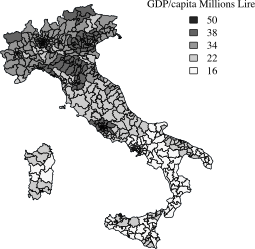
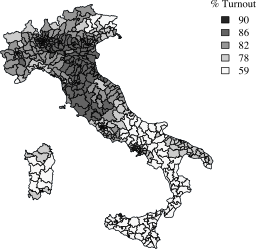
Example: Italian Elections

Ward and Gleditsch (2018), Figure 2.3

Ward and Gleditsch (2018), Figure 2.4

Will OLS “Work” Here?

  • Can we use OLS to derive the BLUE of the effect of GDP on voting?
Plain OLS
\(N = 477\) \(\widehat{\beta}\) SE \(t\)
Intercept 35.30 2.21 15.96
Log GDP per cap 13.46 0.65 20.84

Moran’s \(I\) for residuals = 0.47(!)


Spatial Regression
\(N = 477\) \(\widehat{\beta}\) SE \(t\)
Intercept 4.70 1.66 2.80
Log GDP per cap 1.77 0.48 3.66
\(\rho\) 0.87 0.02 36.7

What Does it Mean that “Spatial Effect” is Significant?

(From the future… your HW4!)

Case 1: No Residual Spatial Autocorrelation

  • Example: Residuals have Moran’s \(I\) near 0…
  • …Don’t need GIS at all!

Case 2: Conditional Autoregressive Model (CAR)

  • GIS, but… only for “fixing” your regression

\[ Y_i = \underbrace{\mu_i}_{\text{Non-spatial model}} + \underbrace{\frac{1}{w_{i,\cdot}}\sum_{j \neq i}(Y_j - \mu_j)}_{\text{Spatial Autocorrelation}} + \varepsilon_i \]

Case 3: Simultaneous Autoregressive Model (SAR)

  • The main event! Here we are explicitly modeling “spatially lagged” versions of our dependent variable \(Y\)!

\[ Y = \mathbf{X}\beta + \rho \underbrace{\mathbf{W}Y}_{\mathclap{\text{Spatially-lagged }Y}} + \boldsymbol\varepsilon \]

Immediately-Relevant Tools for Final Projects! (The Coming Weeks)

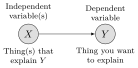
  • Research Methodology (Hypotheses)
  • Visualizing Spatial Data
  • Weighted Connection Matrices \(\mathbf{W}\)
  • Remote-Sensed / Raster Data
  • Data Anonymization / Synthetic Datasets

Research Methodology: Hypotheses

Social Science (McCourt):
Machine Learning (DSAN):
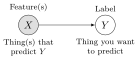
(Secretly My Opportunity to do More Spatial Regression!)

  • What explains previously-observed instances of separatist insurgencies?
  • Can we predict separatist insurgencies?
  • One (spatial) idea: how far away are [centers of power] from [regions of countervailing power]?
  • \(X\) = Distance from capital, \(Y\) = Insurgency
  • Unit of observation: Regions? Insurgent uprisings? Countries?

Operationalizing

  • The variables in previous slide are conceptual
  • Operationalizing = “Turning into measurable quantities”
  • \(X\) = MeanDistance(Capital, Insurgent Region), \(Y = \mathbf{1}[\text{Insurgency}]\)
  • Alternative:

\[ Y = \begin{cases} 2 &\text{if Successful Insurgency} \\ 1 &\text{if Failed Insurgency} \\ 0 &\text{if No Insurgency} \end{cases} \]

Connection Matrices

  • spdep
  • Neighbors if Centroids are close
  • Neighbors if Capitals are close
  • 🤔

Remote-Sensed / Raster Data

  • You’ve seen (to some extent) terra
  • stars: Same group behind sf
  • Google solar panel data
  • .tif files: Dynamically loaded

Anonymization / Synthetic Datasets

  • Differential privacy
  • Used by the US Census(!) Since 2020

Example: Bolshevik Revolution \(\rightarrow\) “Bipolar” World

  • Null hypothesis: no spatial effect of democratization/de-democratization on neighboring countries
  • If null hypothesis is true, and countries democratize/de-democratize independently… could this pattern still arise?

References

Ward, Michael D., and Kristian Skrede Gleditsch. 2018. Spatial Regression Models. SAGE Publications.