Week 10: Cryptographic Hash Functions: RSA and Diffie-Hellman
DSAN 5500: Data Structures, Objects, and Algorithms in Python
Thursday, March 19, 2026
The RSA Algorithm
The RSA public-key cryptosystem relies on the dramatic difference between the ease of finding large prime numbers and the difficulty of factoring the product of two large prime numbers [@cormen_introduction_2001, §31.7]
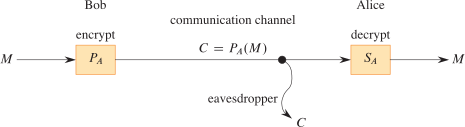
Bob encrypts \(M\) using Alice’s public key \(P_A\) and transmits the result \(C = P_A(M)\) over a communication channel to Alice. An eavesdropper who captures \(C\) gains no info about \(M\). Alice decrypts \(C\) using her secret key to obtain the original message: \(M = S_A(C)\)
Task 2: Signing a Message!
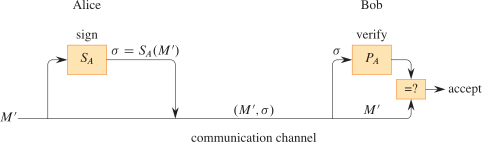
- Alice computes her digital signature \(\sigma = S_A(M')\), then sends the pair \((M', \sigma)\) \(\rightarrow\) Bob
- When Bob receives \((M', \sigma)\), he verifies that it originated from Alice by using Alice’s public key to check \(M' = P_A(\sigma)\)